September
Multiple Perspectives · Courtroom Memory · Mandatory Reporting
That question,
landed in every adult’s heart
It did not stop at the witness stand. It crossed the courtroom walls like a mirror held up to Taiwanese society.
Published 2026.09.03 · Testimony excerpt expanded 2026.09.05

Three knocks
The warning signs did not appear on the same day
October
Listlessness
November
Three teeth lost in one night
Essay
A child’s days were so short; the adults’ waiting was so long
Later, whenever I thought of that day, the first thing I remembered was not the testimony, but three teeth.
I did not see it myself. I only heard in court that Kaikai had lost three teeth in a single night. Baby teeth should flash white in a smile. Instead, they became three silent white dots, fallen into days that could never be pieced together again.
That day, I sat in the public gallery with a pen in my hand. The judge asked, in sequence, about extensive bruising in September, listlessness in October, and three teeth lost in one night in November. The signs kept returning, like someone knocking again and again from behind a door, while no one outside truly heard.
Bai Lifang continued to speak of process, division of work, gathering information, and discussions with supervisors. Her answers moved between “clear evidence” and “report when abuse is suspected,” prompting the judges to ask again and again. Each answer seemed to have its own context, yet set beside a child who had died, the words felt especially cold.
The adults’ procedures moved at their own pace. The child’s suffering also moved forward, day after day. The two never met where they most needed to.
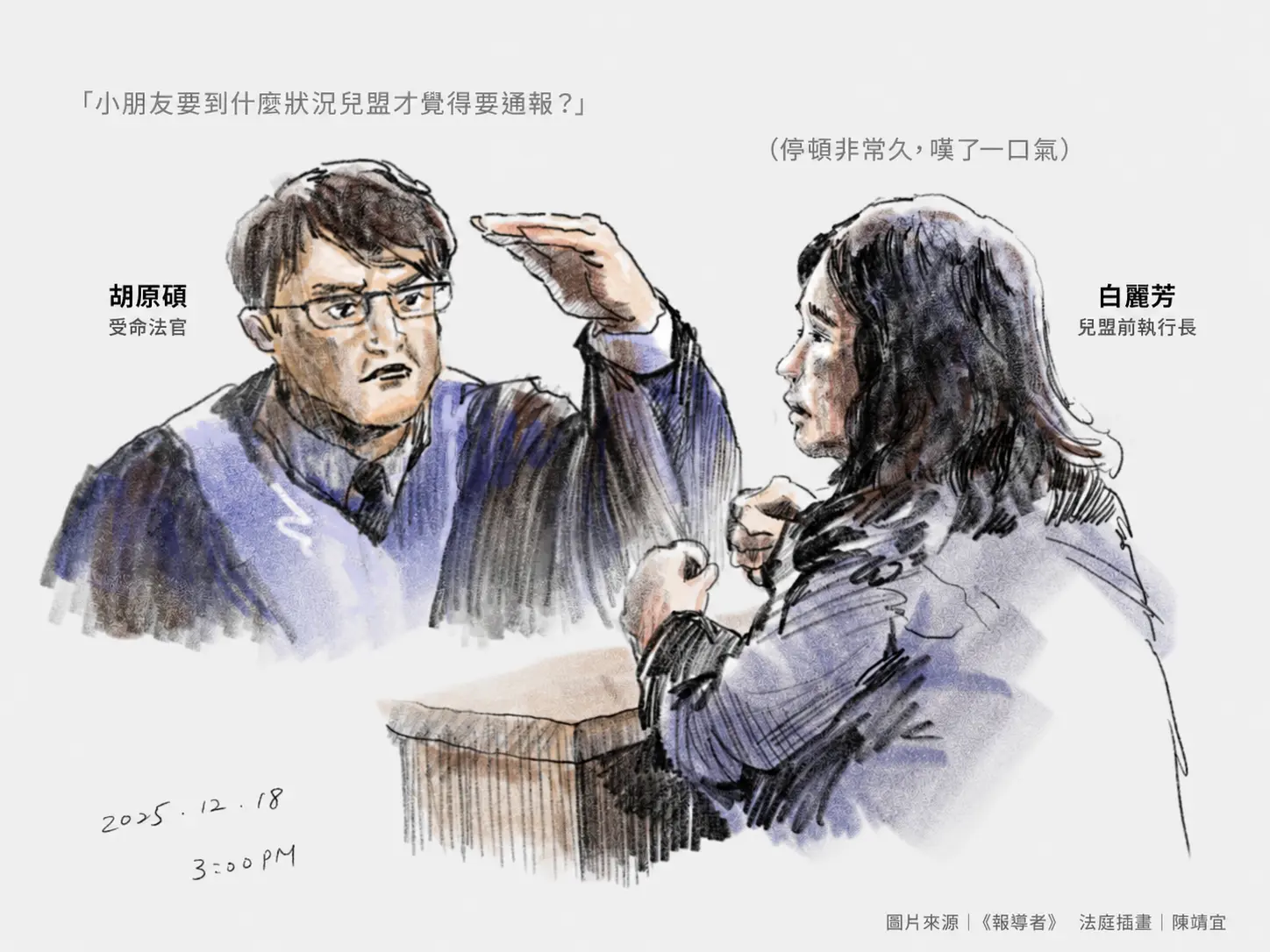
Then the judge’s voice grew firmer:
Then what exactly would it take for the Child Welfare League Foundation to consider itself obligated to report? Must a child be beaten until their whole body is covered in injuries, with broken arms and legs, before it counts?
After that question, people in the public gallery cried in distress and proceedings were briefly interrupted. Bai Lifang did not directly address the specific circumstances at the time. She subsequently referred first to “clear evidence,” then explained that suspected abuse or mistreatment triggers the duty to report.
Yet the witness stand was not the only place that fell silent. The question crossed Bai Lifang, CWLF, and the courtroom walls, holding a mirror up to Taiwanese society. In that mirror were social workers, institutions, competent authorities, and every one of us who might notice that something is wrong with a child.
It forces everyone to answer: have we mistaken reporting for conviction, turned caution into waiting, and passed a child’s danger to the next person? When another child pleads through injuries, will Taiwanese society still wait until the child is covered in wounds before believing that the child is suffering?
In the silence, a woman in the public gallery began to sob. A female court officer walked over and bent down to comfort her. Watching them, I felt an even deeper ache: when an adult cried, someone immediately came to hold her. But what about Kaikai?
He was so young that he could not explain his fear; he could only write the pain on his body. A bruise was one sentence, exhaustion another, and three lost teeth another. Had someone been willing to read them together, they would have understood: this was a plea for help written by a child’s body.
But the adults took the letter apart. Bruises were explained as falls, listlessness as difficulty adjusting, and missing teeth as the result of grinding. Each explanation erased one line of the plea. Each delay carried the letter farther from the person who needed to receive it.
By the time everyone finally understood it, the child who had written the letter was gone.
Reporting is not a conviction. It means looking once more, asking one more question, and inviting another pair of eyes to check whether a child is safe. Sometimes saving a child does not require waiting until the whole truth is known; it begins with refusing to look away.
The crying eventually stopped and the proceeding continued, but the judge’s question never left.
It was not that Kaikai said nothing. His words remained in the bruises, the exhaustion, and three small teeth. The adults simply read too slowly. When we finally unfolded that plea for help, we saw what it had said all along:
I am already hurting this much. How much longer will you wait?
* The essay was compiled from courtroom-observer notes and reporting by The Reporter. The Q&A below is translated from courtroom-observer notes dated December 18, 2025; it is not an official verbatim transcript released by the court.
Full Testimony Excerpt
Bai Lifang was asked again and again: after recognizing the signs, when should a report be made?
The following is translated from courtroom-observer notes dated December 18, 2025. It preserves the order of questioning and annotations for silence or words that could not be heard clearly. It is neither an official verbatim transcript released by the court nor a court finding.
The witness said social workers had received basic training on recognizing child abuse before the incident, but she could not describe the course content in detail.
The judges placed the extensive bruising, listlessness, and teeth lost overnight on a single timeline.
After questioning over her reference to “clear evidence,” the witness ultimately confirmed that suspected abuse should be reported.
An associate judge sought a direct answer on whether ensuring that the child was properly cared for and protected was the social worker’s duty.
Earlier excerpt | Recognizing abuse, training, and reporting Questions from the defense and prosecution about training, service experience, and the threshold for recognition
Defense counsel
Before this case, did CWLF require social workers to take training on recognizing child abuse?
Bai Lifang
There was a basic three-hour course on recognizing child abuse.
Defense counsel
They were required to take a course, but it was only a basic course?
Bai Lifang
Yes.
Defense counsel
Is it easy to recognize child abuse?
Bai Lifang
No. The Ministry of Health and Welfare has established many child-abuse medical centers. Cases that may involve child abuse must be photographed and sent to a center for confirmation.
Defense counsel
Why does your answer differ from the statement recorded by the prosecution?
Bai Lifang
I had already left my position then, and the questioning was lengthy. I had not seen the visit reports or details, and I did not know how to explain the prosecutor’s compound questions. For example, mandatory reporting applies when we discover suspected abuse, but at the time we had not discovered it.
Prosecutor
When first-level supervisor Li Fangling testified previously, she said CWLF’s child-abuse course was of course different from this “12-point reminder on clinical signs of child maltreatment.” Your course sounds quite extensive. Please specify what it covered. Did you take it?
Bai Lifang
I did. We invited physicians to teach, but I cannot describe the specific course content.
Prosecutor
Does CWLF provide abandoned-child protection services?
Bai Lifang
Yes.
Prosecutor
Had it ever served a child who was abused by a licensed caregiver?
Bai Lifang
No. I do not remember.
Prosecutor
In 33 years of service, you never encountered a child abused by a licensed caregiver? This is not limited to adoption services.
Bai Lifang
Correct, no.
Prosecutor
What did CWLF’s internal review meetings examine after the incident?
Bai Lifang
Different levels conducted different reviews. I later left my position, so I do not know.
Prosecutor
So you do not know what the adoption team reviewed?
Bai Lifang
As I understand it, one question was whether child-protection services should be contacted when a child is injured in the future.
Prosecutor
The short-term placement and childcare guidelines state: “one visit per month and unscheduled phone calls to assess how children awaiting adoption are being cared for.” What exactly was to be assessed?
Bai Lifang
We collected information about the child’s condition.
Prosecutor
You say “collect information about the child’s condition.” Does that mean there was no need to examine why the child was in that condition?
Bai Lifang
We looked into the condition.
Prosecutor
If a child had a personal-safety issue, would you act?
Bai Lifang
Of course. But personal safety is broad, and at the time it was not judged to be a personal-safety issue.
Complete continuous passage | Judges repeatedly ask about recognition, suspicion, and reporting From September bruising, October listlessness, and November tooth loss through the final question
The passage below runs continuously from the assigned judge’s first question about the three warning signs through the end of this witness’s examination. No intervening question or answer has been removed.
Assigned judge
If the first visit was in September, another in October, and such a drastic deterioration appeared by November, could the social worker conclude that the child was not receiving proper care?
Bai Lifang
I was not involved in this case and have not seen the complete records, so I cannot draw a direct conclusion. But I believe many considerations informed the decision at the time. Generally, when a child develops problems, social workers want the child to see a doctor first, such as a pediatrician or dentist, and seek medical expertise to help assess the situation. In adoption work, children often have adjustment difficulties when their care environment changes, so the team may initially have understood the situation as an adjustment problem.
Assigned judge
In your understanding, what should a social worker do when faced with such a drastic change?
Bai Lifang
There should be a discussion. After that, more time may be needed to gather information. If the available information is still considered insufficient to make a judgment, they may decide to have the child see a doctor first.
Assigned judge
So all the social worker should do is have him see a doctor?
Bai Lifang
Looking back, one may feel that more should have been done. But I was not actually involved in this case. All I can say is that each judgment was based on the information available at the time, consultation results, and past experience and professional knowledge.
Assigned judge
Then what exactly would it take for the Child Welfare League Foundation to consider itself obligated to report? Must a child be beaten until their whole body is covered in injuries, with broken arms and legs, before it counts?
Bai Lifang
I cannot directly answer about the specific situation at the time. But based on our past management experience, if there is clear evidence suggesting that a child may have been abused, it should be reported. However, the legal duty to report actually arises when abuse or mistreatment is suspected.
Bai Lifang
I also explained to the prosecutor that the questions often combine several issues. For example, a video is shown and I am asked whether it depicts abuse; I answer that I cannot determine that. Then the question turns to mandatory reporting, and I say that suspicion should be reported. This is then linked to whether emergency placement would follow a report. These issues cannot be explained clearly in a single sentence.
Assigned judge
In this statement, the prosecutor asked, “If a social worker discovers an injury, should it be reported within 24 hours?” You answered, “When an injury is discovered, it should be reported within 24 hours.” The prosecutor asked, “If a report had been made, would there have been an emergency placement so the child would not have died?” You answered, “Yes.” Is that position consistent with your answer now?
Bai Lifang
At the time I was answering about mandatory reporting: a report is made when abuse is suspected, not merely when there is an injury.
Assigned judge
Looking at it now, the defendant—your social worker—saw a huge change but did not report it. Do you think she fell short?
Bai Lifang
Our administrative procedures should be improved. Criminal responsibility is for the judge to decide.
Assigned judge
In these circumstances, did you really have no defined requirements?
Bai Lifang
(Silence) It needs improvement, but it was not a failure.
Assigned judge
As a supervisor, how do you evaluate the defendant’s handling of the matter? Did she do what an ordinary social worker should have done?
Bai Lifang
(Silence) There was room for improvement.
Assigned judge
What should have been done to meet your expectations?
Bai Lifang
I think that, beyond discussion, more medical professional resources should have been sought.
Associate judge
You just said “unannounced visits” are for the government. Because CWLF does not exercise public authority, did it conduct only scheduled visits?
Bai Lifang
Under the regulations, yes.
Associate judge
Do the regulations say that an unannounced visit cannot be made when a child is not under state placement?
Bai Lifang
No, they do not.
Associate judge
You just said it was impossible to guarantee the child’s safety 24 hours a day. But was ensuring that the child received good care and protection in the home-based childcare setting Chen Shangjie’s responsibility and duty?
Bai Lifang
That was the home-based childcare center’s role, wasn’t it?
Associate judge
So ensuring that the child received good care and protection in the home-based childcare setting was not Chen Shangjie’s duty? Please answer yes or no. Do not digress. This question should not be difficult.
Bai Lifang
(Silence) If I may answer only yes or no, then it was.
Associate judge
At first you said reporting required “clear evidence of child abuse.” Later you said a report should be made when there is “evidence giving rise to suspicion.” From the perspective of a normal, ordinary person, if a child lost three teeth in one night, would the thought of suspected abuse enter your mind when you saw that?
Bai Lifang
That is unusual. Perhaps because I have had too much experience, I… (Observer’s note: the latter part of the response could not be heard clearly and awaits supplementation.)
Presiding judge
So if you had been on the front line alongside Chen Shangjie, would you have handled the situation in the same way?
Bai Lifang
I would have asked a little more.
Presiding judge
Would you have asked the caregiver again and told the caregiver to take him to a doctor?
Bai Lifang
I would have asked a doctor or dentist and consulted a professional.
Presiding judge
Does reporting not count as consultation? Does reporting not bring a professional in to look? Instead, would you find a professional yourself?
Bai Lifang
(Silence)
Presiding judge
Excuse me. Is a report required when there is suspicion, or only after confirmation? It is all right if you cannot answer.
Bai Lifang
On suspicion.
Assigned judge
Consultation should have begun when bruising was discovered in September. By November 19, when three teeth were lost in one night, do you think she had clarified these signs of suspected abuse within an appropriate time?
Bai Lifang
I was not the first to know. Many children awaiting adoption have many issues. She was not proactive enough, but she was not inactive.
Assigned judge
So you are saying she was not proactive enough?
Bai Lifang
In hindsight.
Assigned judge
Then when would have been the appropriate time to seek confirmation of abuse? The judge considers that a long period had already passed.
Bai Lifang
They did ask the caregiver. At the time they sought play therapy and treated it as difficulty adjusting.
Assigned judge
With injuries over such a large area, did this really look like adjustment difficulty rather than abuse? After three or four months, did that meet the “due-care standard expected of a social worker” [wording in the observer notes]? I am asking you now: was this reasonable?
Bai Lifang
I cannot answer this weighty question. We would check whether she discussed it with her supervisor. I do not want to make excuses for her. We simply trusted the caregiver who worked with us.
Assigned judge
Was that not an error of judgment plainly inconsistent with the objective evidence?
Bai Lifang
(Silence) I would call it a limitation, not an error.
Record Boundaries and Legal Responsibility
Reporting begins a protection process; it is not a conviction
The limits of recording “did not answer”
The phrase “Bai Lifang did not answer” describes the pause at the witness stand immediately after the judge’s question and the break in the exchange at that moment. It does not mean that Bai made no further statements later in the proceeding. She subsequently addressed the reporting threshold, the information available at the time, and the decision-making process.
Mandatory reporting within 24 hours
Under Article 53 of Taiwan’s Protection of Children and Youths Welfare and Rights Act, social workers and other mandated reporters who learn in the course of their work that a child or youth has suffered a listed injury or improper treatment must immediately report to the competent authority, and no later than 24 hours. Ministry of Health and Welfare guidance also describes suspected improper treatment as a reporting circumstance; complete evidence sufficient for conviction need not first be obtained.
Responsibility in the individual case remains for the courts to determine
A report starts the competent authority’s triage, investigation, and protection procedures. It is not a finding that a caregiver committed abuse, a criminal conviction, or an automatic decision to make an emergency placement.
This article combines courtroom-observer recollection, reported material, and literary narrative. It does not mean that a court has determined the legal responsibility of Bai Lifang, CWLF, or any other person. Whether the reporting duty was breached, whether any legal causal connection exists with the harm, and whether civil, administrative, or criminal liability follows must be decided under the law in force at the time, the complete evidence, and the court’s judgment.
May the next child be reached before harm occurs.