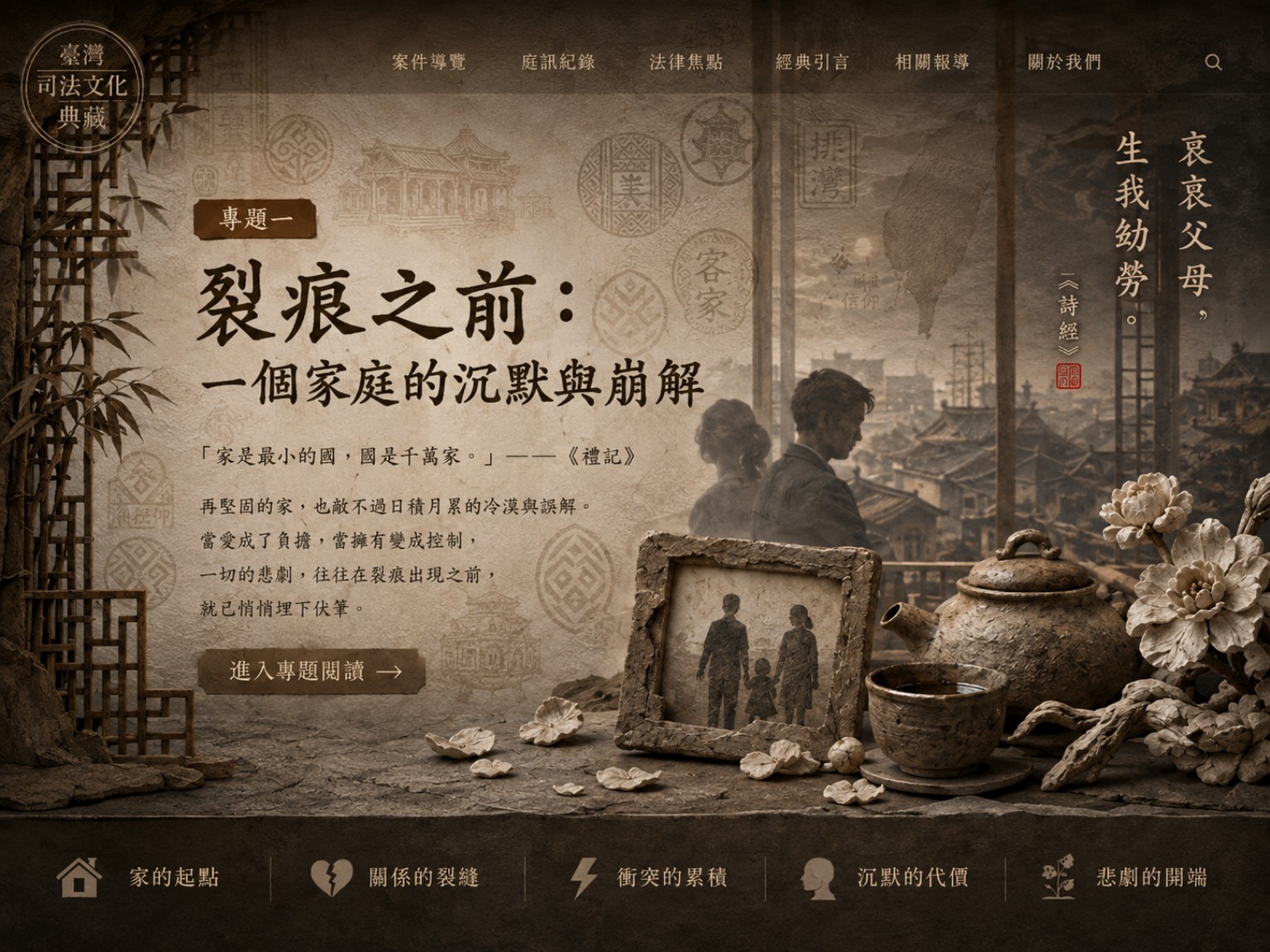
A home is not ownership, but a life of mutual respect
Some families collapse without a loud crash. At first, voices simply become sharper, movements must be accounted for, refusal is read as betrayal, and leaving is treated as humiliation. By the time someone can no longer live according to their own will, an intimate relationship has quietly become a relationship of power.
The incident occurred on July 7, 2025. After a hearing on an ordinary protection order, Mr. Hsieh followed his wife and her younger sister by car, rammed the scooter they were riding, then attacked them with a blade and an aluminum rod, killing both. The tragedy unfolded on a street, but its history already lay in family conflict, violence, protection orders, and the difficulty of leaving a relationship.
“The foundation of the world lies in the state; that of the state in the family; that of the family in oneself.”Mencius, Li Lou I
Read gently, this does not tell us to shut families behind closed doors. It reminds us that the smallest and most real starting point of public safety is each person's willingness to restrain themselves in an intimate relationship and recognize that others are not possessions.
Before and after a protection order
“Tread on frost, and solid ice is coming.”Book of Changes, Kun
When one steps on thin frost, thick ice has not yet appeared, but the cold has already left a signal. A gentle modern reading is that domestic-violence risk must not become visible only after the gravest harm: stalking, property destruction, threats, and control may all signal escalating danger.
When “I have lost everything” obscures other people's lives
The victims' representative argued in court that the order of attack reflected control, cruelty, and revenge, intended to make the wife witness her sister being harmed. The prosecutor presented “four steps of premeditation”—forming the intention, acquiring tools, approaching the targets, and using the tools. Mr. Hsieh explained these stages as “scaring them,” “a voice told me to buy them,” “meeting by chance,” and “not being able to tell the tools apart,” but the prosecutor argued that the conduct as a whole remained continuous.
These were courtroom arguments; findings ultimately depend on the court's assessment of evidence. For society, a more important question is this: when someone's self-worth rests entirely on whether another person stays, love may be mistranslated into possession, and leaving into an injury against them.
“Those who wish to put their families in order first cultivate themselves.”Book of Rites, The Great Learning
Applied today, this does not ask any victim to endure abuse. It places responsibility back on the person acting: a stable home depends first on each person's willingness to address their anger, frustration, and desire for control—not on demanding that others purchase peace through submission.
Children lose more than a mother
The prosecutor asked in court, “Who left the children without their mother?” and argued that children's best interests should not instead become a shield for the perpetrator to seek exemption from death. The defense argued that children should retain the possibility of seeking answers for themselves when they grow up.
Children often lose more than a family member through domestic violence. Their sense of safety, daily order, trust in intimate relationships, and a childhood free of responsibility for adults' choices can shatter together. No judgment can fully restore these things, but institutions should at least recognize that children's present feelings deserve respect in their own right.
“Alas, my parents, who labored so hard to raise me.”Book of Songs, Minor Odes, Liao E
The ancient verse recalls gratitude for parents' care. In this case, we prefer to read it as a quiet reminder: children should not be forced between their parents' conflicts, nor pay a lifelong price for adults' violence through losing those closest to them.
A protection order is not the endpoint, but the beginning of a high-risk period
“In safety, the exemplary person does not forget danger; in survival, destruction; in order, disorder.”Book of Changes, Appended Statements II
This does not ask everyone to live in fear. It means that reliable institutions do not let go merely because things seem temporarily calm. Especially around separation and protection-order proceedings, preparations must account for the worst possible consequences.
Leaving a violent relationship can never be explained by “Why didn't you leave sooner?” Leaving safely requires information, transport, shelter, legal accompaniment, confidential contact, financial support, and continued follow-up. Institutions must ensure that seeking help is no longer a risk borne alone.
The first-instance judgment and the judicial process still ahead
On August 21, 2026, New Taipei District Court delivered its first-instance judgment. According to the court's press release: three months' imprisonment for assault; 59 days' short-term detention for violating a protection order; life imprisonment and lifelong deprivation of civil rights for each of two murder counts, with an aggregate sentence of life imprisonment and lifelong deprivation of civil rights. The case remained subject to appeal.
The judgment is not the end of the story. An appeal may follow, and life does not automatically recover upon sentencing for the victims' relatives and children. Justice can address responsibility and punishment; society must still answer whether, when the next person seeks help, we can recognize danger earlier and help her leave safely.
Sources and editorial methods
This feature separates three layers: court-confirmed procedure and judgments; arguments by prosecutors, defense counsel, and the victims' side; and editorial reflection on institutions. We do not invent wording, tool inventories, or expert-assessment details that the observer could not verify.
If you or someone nearby faces domestic violence or stalking threats, contact Taiwan's 113 protection hotline on a safe device. For immediate danger, call 110; for emergency medical help, call 119. Do not leave records of seeking help on a device that may be monitored.