SENTENCING EVIDENCE · DAY 8
Original Prison Watch recordReading guide reconstructed by Child Protection Action Alliance
Eighthtrial hearing
Kaikai citizen-judge trial record | Monday, May 5, 2025
Sentencing does not turn harm into a formula: it requires every argument to return to evidence, responsibility and the possibility of reintegration.

This page concerns child maltreatment, death and sentencing evidence. Testimony, expert explanations and parties’ arguments reconstruct Prison Watch’s published DAY8 record and are not final judicial findings. The source uses both “嚴O娟” and “顏O娟”; pending spelling confirmation, this page says “Child A’s grandmother.”
Day 8 at a glance
Proceedings moved from investigating the offense to sentencing evidence. Child A’s grandmother testified in the morning. Dr. Hsu Chien-chi explained his sentencing assessment in the afternoon, then answered counsel, prosecutors and the presiding judge.
Today the court must answer more than who said what
It must distinguish offense circumstances and culpability-based sentencing, defendants’ living conditions and character, which post-offense or repair factors can lawfully enter sentencing, and whether possible reintegration means responsibility may be reduced.
09:37–16:38 | How proceedings advanced
- Hearing continued
The presiding judge explained sentencing issues and evidence procedure; prosecution and defense made sentencing opening statements.
- Child A’s grandmother testifies
Care, adoption decisions, pre-handover condition, post-incident contact, settlement and ancillary civil proceedings.
- Morning recess
The judge reminded parties of witness-questioning time arrangements.
- Dr. Hsu Chien-chi explains the assessment
Purpose, sources, both defendants’ backgrounds, psychological testing, risk and reintegration prospects.
- Sworn as a witness and questioned
Answers both defense counsel and prosecutors from personal observations.
- Presiding judge’s questions after recess
Assessment experience and the plain meaning of “external controls.”
Three sentencing stages | Separate responsibility from personal information
Organized from the parties’ statements and judge’s reminders in the original record: a reading framework, not a sentencing formula invented by this page.
Offense circumstances and culpability-based sentence
Role in the conduct, danger or harm caused, victim-family attitudes, and the upper responsibility limit supported by the offense itself.
Future reintegration prospects must not be projected backwards into offense facts.General circumstances and personal information
Living conditions, character and intellectual/educational level, and whether these have an evaluable connection with the offense.
Background information does not automatically mitigate responsibility.Post-offense attitude, repair and reintegration
Treatment motivation, social support, reoffending risk, rehabilitation prospects, victim repair and other legally permissible factors.
Possible reintegration does not require reductions at the first two stages.Grandmother’s testimony | Care, adoption and repair boundaries
The source heading and Q&A table spell the name differently, so only the family relationship is used here.
The grandmother said she cared for A for about two months. Because his mother could not care for him, a social-affairs bureau recommendation and Child Welfare League Foundation referral led to adoption proceedings.
She described him as healthy, lively, mischievous and lovable; she began crying as she spoke about him.
Neither defendant contacted her. The foundation contacted her once; she refused. Defendants’ relatives discussed compensation and settlement, which she did not want.
She was unsure whether an ancillary civil action had been filed. The victim-participation representative stated in court that none had been filed at that point.
“I really blame myself; I truly had no way. No one should do such terrible things to such a small child.”— Testimony recorded in Prison Watch’s published DAY8 account
Grandmother and other witnesses | Return to original answers for each comparison
Select a source label to open the corresponding DAY8 answer or another day’s full testimony. DAY8 cards also link back to this table.
Comparison topicDAY8 referenceOther witnesses / datesReading the comparison
Pre-handover health and development
Q06 · PDF p.2 | Visit frequencyQ07 · PDF p.3 | Care by ChouQ12 · PDF p.3 | Pre-handover impression
DAY3 | Chou ○ full Q&ADAY3 | Hsiao ○-hsiang full Q&A
Mutually consistentThe grandmother, Chou and Hsiao reported no special care difficulties during their respective care/visits. This establishes an early baseline only, not the child’s daily condition later.
Adoption and care transitions
Q02 · PDF p.2 | Transfer to HsiaoQ03 · PDF p.2 | Adoption processQ08 · PDF p.3 | Adoption reasonsQ11 · PDF p.3 | Changing carer
DAY3 | Chou’s handover testimonyDAY3 | Hsiao’s handover testimony
Complementary process accountsThey respectively explain family decisions, referrals and actual handovers. Procedural points can be connected, but family motives, social-worker decisions and contracts are different evidence.
Post-handover visits and contact
Q10 · PDF p.3 | No visits after handover
Different rolesThe grandmother did not visit because parting was painful. Chou requested visits unsuccessfully. These are different people’s contact routes, not one event or a contradiction.
Post-incident contact and repair
Q15 · PDF p.3 | Defendant/foundation contactQ17 · PDF p.3 | Compensation/settlementQ19 · PDF p.3 | Ancillary civil action
Other published testimony currently lacks complete answers matching the grandmother’s scope. Counsel contacts, victim participation and procedural documents need separate checking.
Do not fill gapsContact, apology, settlement, compensation and ancillary civil action must be read separately. Do not speculate when matching sources are absent.
Two sentencing assessments | Same conclusion, different risk pathways
These are Dr. Hsu’s recorded assessment explanations and answers, not diagnoses made by this page or opinions necessarily adopted in full by the court.
- Reduced responsibility
- The expert found no living-condition, character or intellectual/educational factors justifying reduced responsibility.
- Mental-illness information
- Claims of long-term voices and schizophrenia lacked objective support; timing of statements and functional presentation required checking.
- Risk
- The assessment described ongoing conduct, not a single chance event, indicating continuing future risk.
- Reintegration
- Change and reintegration remain possible, subject to treatment motivation, individualized intervention and separation/external-control factors.
- Reduced responsibility
- The expert likewise found no room to reduce responsibility for living conditions, character or intellectual/educational level.
- Psychological characteristics
- The record mentions negative emotion, symptom minimization, repression/control, limited self-awareness, cognitive distortions and moral disengagement.
- Risk
- She can follow rules in most settings, but may be readily influenced by significant others.
- Reintegration
- Removing the influence arising from her relationship with Caixuan would improve her chance of reintegration, the expert said.
The crucial distinction
“No reason to reduce responsibility” and “reintegration remains possible” can both be true. One addresses sentencing-factor reduction, the other future change; neither substitutes for the other.
Dr. Hsu and other doctors | Factual foundation, sentencing and professional limits
This does not merge four doctors’ opinions into one assessment; it identifies where they connect, complement each other, or cannot corroborate each other.
Comparison topicDr. Hsu’s DAY8 referenceOther doctors / witnessesReading the comparison
Can self-injury explain the child’s condition?
Q28 · PDF p.7 | Child’s acts uncertainQ46 · PDF p.7 | Not momentary impulsivity
DAY3 | Chou saw no self-injuryDAY5 | Lu Li: 42 injuriesDAY6 | Chiu: psychiatric differential assessment
Multiple sources convergeEarlier carers saw no self-injury; injury medicine does not support explaining everything by self-injury alone; psychiatric assessment requires long-term context. At sentencing, Hsu preserved uncertainty about whether the alleged child behaviors occurred.
How physical/death evidence enters responsibility evaluation
Q46 · PDF p.7 | Why no reductionQ58 · PDF p.8 | Living conditions, character, intellect
DAY5 | Hsu Cho-hsien: death mechanismDAY5 | Lu Li: injury contextDAY6 | Three-level evidence chain
Connecting levelsHsu Cho-hsien, Lu and Chiu establish the child’s physical, death and mental-impact foundation; Hsu Chien-chi addresses defendants’ personal sentencing factors. The former do not automatically determine punishment; the latter cannot rewrite injuries or cause of death.
Defendants’ mental-health claims and treatment motivation
Q44 · PDF p.7 | Claimed mental stateQ48 · PDF p.7 | Treatment motivationQ50 · PDF p.7 | Avoiding treatment
Published testimony of Hsu Cho-hsien, Lu and Chiu principally evaluates the victim child, not the defendants’ psychiatric diagnosis or treatment.
Cannot mutually corroborateVictim-focused forensic, pediatric or psychiatric assessment cannot replace Hsu’s defendant sentencing assessment: the subjects and questions differ.
Risk, reintegration and external controls
Q51 · PDF p.7 | Separation factorQ59 · PDF p.8 | Higher reintegration prospectQ61 · PDF p.8 | External controls
The other three doctors offered no reoffending-risk or reintegration opinions on the two defendants.
Specific to DAY8Reintegration addresses future intervention conditions only; it cannot retrospectively lessen offense facts or offset earlier responsibility evaluation.
Cross-day links lead to published original Q&A or evidence chains on this site. Comparisons are reading indexes, not judicial acceptance or final findings.
Assessment terms | How today’s source uses them
Symptom minimization
The expert explained that people may downplay symptoms on self-report scales and doctors flag this; it does not make every answer unreliable.
Moral disengagement
A psychological mechanism using different cognitions to avoid guilt over one’s own or others’ immoral conduct.
External controls
Environmental controls: parents collecting a child are one example. A closed environment may reduce outside intervention.
4Ps × biopsychosocial model
Predisposing, precipitating, perpetuating and protective factors are crossed with biological, psychological and social dimensions to identify risks and protections.
Risk–need–responsivity model
The source lists loss of childcare qualifications, religion and family support in discussing future risks, intervention needs and support conditions.
Reintegration potential
The prospect of returning to community life after intervention, not diminished responsibility or absence of risk in this case.
Full questioning | Questions left, answers right
Desktop uses two columns; mobile changes to question then answer. Line breaks follow the source PDF table. The sole prompt with no expert answer is expressly blank and is not filled with later procedural remarks.
Showing 61 Q&A pairs
Did you actually care for Child A?
Yes, about two months.
Why transfer him to carer Hsiao?
To entrust him to the Child Welfare League Foundation for adoption.
What was the adoption process?
His mother could not care for him; the social-affairs bureau recommended it, then referred him to the foundation.
Why were you his guardian?
His mother could not be contacted. A guardian was needed, so it changed to me.
What about carer Chou?
She cared for his sister, his paternal half-sister.
Did you visit Child A?
Yes, more than twice a month.
How was Chou’s care?
Very good; he was healthy, lively, mischievous and lovable.
Why choose adoption?
Because we could not manage, and his mother could not care for him. My husband and I earned NT$50,000–60,000 monthly, had our own minor children, and also
the childcare fees for A’s sister and so on.
Did you have to work?
Yes, every day from 8 a.m. to 7 p.m.
Did you know Liu Caixuan?
We met when the foundation handed A over. She seemed ordinary, nothing special. I did not visit: it would hurt to part with him, since he was being adopted.
I heard about A from the social worker.
Why switch from Chou to Liu?
A carer cooperating with the foundation was required.
Your impression of A then?
Very healthy; the little boy was lovely. I’m so sad (begins crying).
How did you feel after A died?
I truly blame myself; I really could do nothing. Such terrible things must not be done to such a small child.
You attended several times; why always leave early?
It hurts too much. A child just over one year old: no one has the right to treat a child this way.
Did the defendants or foundation contact you afterwards?
Neither defendant did. The foundation contacted me once; I refused.
When?
Too long ago to remember. They texted saying they wanted to contact me.
Did defendants or their families discuss compensation or settlement?
Yes, but I did not want it.
How did it happen?
Did they speak to you through a lawyer?
Yes.
Was this to file an ancillary civil action?
I’m not very clear on that.
Was there an influence from detachment or antagonistic personality traits?
She mostly used silent conflict with her husband. She once reported low mood and breaking glass to injure herself, but did not seek care or tell anyone.
Ruolin’s son said his aunt would stop talking when angry.
At work?
I have not heard of it.
No prior convictions or antisocial-personality record: why such a serious crime?
That is something I am very curious about too.
Legal issues remain, so we cannot truly see through it.
Interviewing after the judgment becomes final might offer a better chance to understand.
How did the environment influence events?
Income sources and a closed environment preventing intervention; the other child was cared for without problems.
Conduct arising under multiple factors?
Yes.
A cold marriage or personality traits?
The traits predated it and appeared in the marriage.
How did the antagonistic traits develop?
Caixuan now faces legal issues; references to voices and family factors are all intended to reduce blameworthiness.
Can the factors’ relative weight be distinguished?
They act together; the personal factor is most important.
What opportunity could bring change?
It is difficult to establish whether A really had these behaviors.
Trials involve various strategies. Treatment first requires motivation; currently reducing blameworthiness is a consideration. We must wait
until the judgment is final before it may be possible.
Any method or scale for assessment?
In a long-term therapeutic relationship, yes, but no particular definitive scale.
Can poor awareness change?
It did not happen before, so change is possible.
How long is long-term?
I cannot answer: frequency, duration, intensity and motivation to change all differ.
What treatment in prison?
My knowledge of prison resources is limited; individualized intervention benefits her.
Minnesota Multiphasic Personality Inventory (MMPI): possible symptom minimization?
Expression through repression, high emotionality and somatization (psychosomatic complaints).
What does need for control mean?
For example, caring for a stepson, the in-laws’ business and sending her own children to her parents’ home.
Easily compliant, following others’ wishes?
People she regards as important, whose affirmation she needs.
In this case, could that be Caixuan?
This is the difficult, complex part. Ruolin had been an employer and could be forceful; after divorce there was another
change.
What is symptom “minimization”?
Understatement on self-report scales; doctors raise it when they see it.
Report p.57: changes after Ruolin returned home following divorce?
There is a difference: business and home differ. She became less forceful; time and setting matter.
Report p.48 and slides: three theories—social learning, obedience to authority and cognitive consonance—yield five possibilities/causes to analyze Ruolin’s knowledge of and response to Caixuan’s conduct.
Answer field blank.
The judge noted the report was not admitted and asked that the slides be used; no expert answer is recorded for this row.Did Caixuan’s accounts of her father’s affair and family discord differ from the other relatives’?
Yes, the sisters differ, making the account more questionable.
Any exceptional events in Caixuan’s life?
She witnessed her father abusing her mother; her mother was stricter but did not single her out. She marked finances as “comfortable,” but described the boxed
meals as poorer. Tenants could delay rent. Parts of her upbringing account are questionable.
Finances’ influence on this case?
The children were adults, requiring no extra spending. After 2018 her father changed and brought money home. The foundation paid NT$30,000 per child, parents over NT$20,000;
rent was paid when affordable (the house belonged to her eldest sister). It was not the worst period of her life.
Mr. Wang said Caixuan was excessively involved with temples?
She spent over NT$100,000 addressing health issues there.
What about Caixuan’s mental state?
Not mentioned at the first two interviews; only at the third did she report hearing voices. This differed greatly from diagnostic presentation.
Schizophrenia would markedly impair functioning and others would certainly notice.
Persistent depressive disorder lasting over two years would present differently, so I do not think it was that.
She said she could not afford doctors, but insured her children and paid premiums: inconsistent information too.
Was Caixuan’s diabetes related to the conduct?
Her son said she was more tired. Caixuan kept it in the fives; generally 6.0–6.5, and above 6.5 warrants more
attention.
Pre-meal blood sugar was “120cc” (recommended 99) [unit as recorded].
Anemia was not in the Wanfang medical records either.
Why did your assessment find no basis to lower Caixuan’s sentence?
It was not momentary impulsive loss of control, but prolonged conduct against a child unable to seek help. She could care for her own
children and entrusted children, so there is no possibility of reduction.
Did Caixuan harm herself in detention?
She mentioned biting herself, but I saw no injury.
Caixuan’s reintegration potential?
There must be motivation for treatment.
Has Caixuan admitted wrongful conduct?
A large belly meant she did not think weight had dropped; dressing quickly meant she did not see injuries.
What does distancing from treatment mean?
Not a special psychotherapy term: reluctance and lack of motivation. Rejection naturally affects
treatment.
Caixuan’s social reintegration?
There certainly remains risk without a separation factor.
Did Ruolin have unusual traumatic experiences?
No. The eldest sister said she looked mixed-race as a child and was much loved [source has a typographical error in “eldest sister”].
Was the account of Ruolin and Caixuan’s relationship Ruolin’s own?
Yes.
Have you read the messages?
Yes, and asked about them. The explanation was joking; if she did not want to see it, she clicked away (not addressing the factual conduct).
Would minimization affect tests such as intelligence testing?
Other information, such as education, was considered, so the intelligence test is credible.
Could personality obstruct Ruolin’s psychotherapy?
Yes. Stress relief may come first for now.
Explain moral disengagement plainly.
A psychological mechanism using different cognitions so one does not feel
self-blame for one’s own or others’ immoral actions.
Does the assessment find no reduction under items 4, 5 and 6: living conditions, character and intellectual/educational level?
Correct; there were no adverse developmental factors.
Compliance and yielding fit the overall psychological assessment. Is reintegration more likely?
The premise is Caixuan started and Ruolin joined later. Removing that factor gives a better chance of reintegration.
How many assessment cases have you handled?
Four, two involving sentencing.
What does external control mean?
Environmental factors. A closed environment seems influential, but the other child did not show this. Parents are an external
control because they come to collect the child.
No matching questions and answers.
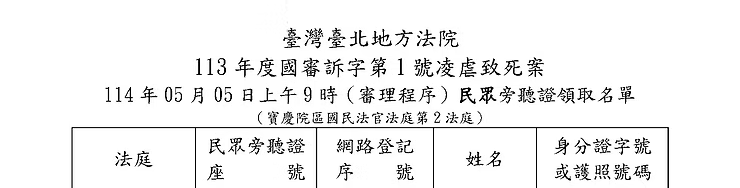
Original image provided by Prison Watch
This public-source image originally appeared on page 1 of DAY8’s PDF. It shows the court, case number, date and header of the public-observer pass collection list. Its source context is preserved; it is not treated as independent evidence of case facts.
第8日|原始紀錄逐列全文(併入完整紀錄)
本區直接依監所關注小組原始公開頁的表格順序重製,共 2 個表格、81 列。不合併問題、不濃縮回答;原始空白欄位保持空白並明確標示。上方導讀與摘要不得取代本區。
原始表格 01|29 列
原始紀錄左欄
檢察官主詰問
原始紀錄右欄
證人顏O娟回答
原始紀錄左欄
有沒有實際照顧過A童?
原始紀錄右欄
有,大概2個月
原始紀錄左欄
為什麼交給蕭保母?
原始紀錄右欄
要交給兒福聯盟出養
原始紀錄左欄
出養的流程?
原始紀錄右欄
因為媽媽沒有辦法照顧,社會局建議,後轉介給兒福聯盟
原始紀錄左欄
為何妳是監護人?
原始紀錄右欄
媽媽聯絡不上。必須有監護人,所以改成我
原始紀錄左欄
周保母呢?
原始紀錄右欄
照顧過姐姐,同父異母的姐姐
原始紀錄左欄
有沒有去看過A童?
原始紀錄右欄
有,一個月2次以上
原始紀錄左欄
周保母照顧得如何?
原始紀錄右欄
照顧得很好,很健康、很活潑、很調皮、很可愛
原始紀錄左欄
為何決定出養?
原始紀錄右欄
因為我們無能為力,媽媽沒辦法照顧。我和先生一個月收入5、6萬元,自己還有未成年子女,還有A童姐姐的保母費等
原始紀錄左欄
妳要上班嗎?
原始紀錄右欄
要,每天早上8點到晚上7點
原始紀錄左欄
認識劉彩萱嗎?
原始紀錄右欄
兒福聯盟交接A童時有接觸,和一般一樣,沒什麼特別的。沒有去探望過,會捨不得,要出養了。從社工處有得知A童的情形
原始紀錄左欄
為何要從周保母換成劉保母?
原始紀錄右欄
因為要有和兒福聯盟配合的保母
原始紀錄左欄
對A童當時的印象?
原始紀錄右欄
很健康,弟弟很可愛,我很難過(開始哭泣)
原始紀錄左欄
審判長:要休息一下嗎?檢察官還有幾題?
檢察官:5題
原始紀錄右欄
原始紀錄回答/右欄空白
原始紀錄左欄
A童死後的感覺?
原始紀錄右欄
我真的很自責,我真的無能為力,不應該對這麼小的小孩做出這麼可怕的事
原始紀錄左欄
有來旁聽幾次為什麼都先離開?
原始紀錄右欄
真的太痛,1歲多的小孩,沒有權力這樣對待一個孩子
原始紀錄左欄
劉彩萱辯護人反詰問:沒有問題
劉若琳辯護人反詰問:沒有問題
檢察官覆主詰問;沒有問題
原始紀錄右欄
原始紀錄回答/右欄空白
原始紀錄左欄
10:25休庭。10:40入庭
原始紀錄右欄
原始紀錄回答/右欄空白
原始紀錄左欄
國民法官(3號)詢問
原始紀錄右欄
證人顏O娟回答
原始紀錄左欄
事發後被告和兒福聯盟有找過妳嗎?
原始紀錄右欄
兩位被告沒有,兒福聯盟找過我一次,我拒絕了
原始紀錄左欄
審判長詢問
原始紀錄右欄
證人顏O娟回答
原始紀錄左欄
何時?
原始紀錄右欄
時間太久我不記得了,是傳簡訊來,說想跟我聯繫
原始紀錄左欄
被告或被告的家人有找妳談賠償、和解嗎?
原始紀錄右欄
有,但我不願意
原始紀錄左欄
過程是怎麼樣?
他們是透過律師跟妳講的嗎?
原始紀錄右欄
是
原始紀錄左欄
是要提附帶民事訴訟嗎?
原始紀錄右欄
不是很清楚
原始紀錄左欄
審判長依序詢問檢察官、辯護人、訴訟參與代理人表示意見
檢察官沒有意見
劉彩萱辯護人沒有意見
劉若琳辯護人沒有意見
訴訟參與代理人:請法官能理解家屬的悲慟
原始紀錄右欄
原始紀錄回答/右欄空白
原始紀錄左欄
審判長問訴訟參與代理人有要提附帶民事訴訟嗎?
訴訟參與代理人:目前沒有
原始紀錄右欄
原始紀錄回答/右欄空白
原始紀錄左欄
審判長:大家都有申請詰問證人結果都沒有問,時間安排都減少很多,要調整時間
原始紀錄右欄
原始紀錄回答/右欄空白
原始紀錄左欄
10:53休庭
原始紀錄右欄
原始紀錄回答/右欄空白
原始表格 02|52 列
原始紀錄左欄
劉彩萱辯護人主詰問
原始紀錄右欄
證人徐堅棋醫師回答
原始紀錄左欄
有無受到疏離、對抗人格的影響?
原始紀錄右欄
與先生多採冷戰,有次提到情緒低落打破玻璃自傷,但沒有就醫等也沒告訴別人
劉若琳兒子說,姨媽媽生氣時會不講話
原始紀錄左欄
工作中呢?
原始紀錄右欄
沒聽說
原始紀錄左欄
無前科、無反社會人格紀錄,為何會犯下大罪?
原始紀錄右欄
這也是我很好奇的
因為還有法律問題,無法真正看穿
等定讞後再訪談可能比較有機會瞭解
原始紀錄左欄
環境因素對事件的影響?
原始紀錄右欄
經濟來源、封閉環境無法介入,另外一個孩子照顧是沒問題的
原始紀錄左欄
是多重因素下的行為?
原始紀錄右欄
是
原始紀錄左欄
夫妻關係冷淡還是人格特質?
原始紀錄右欄
人格特質是更早之前,表現在婚姻關係上
原始紀錄左欄
為何會形成「對抗」的人格特質?
原始紀錄右欄
劉彩萱現在面對法律上的問題,指幻聽、家庭因素等都意在降低可責性
原始紀錄左欄
能否分辨因素的輕重?
原始紀錄右欄
都加在一起造成,個人是最重要的影響
原始紀錄左欄
在何契機下有可能改變?
原始紀錄右欄
A童是否真有這些行為難以確定
審理過程中會有各種策略,治療要先有動機,目前會有減低可責性的考慮,要等定讞後,才有可能
原始紀錄左欄
有沒有什麼方式或量表可以評估?
原始紀錄右欄
長期治療的關係裡可以,但沒有什麼一定的量表
原始紀錄左欄
感知差,有否可能改變?
原始紀錄右欄
以前沒發生過,所以有可能改變
原始紀錄左欄
長期需要多久的時間?
原始紀錄右欄
沒辦法回答,頻率、時間、強度、自己改變的動機都會有差別
原始紀錄左欄
在監所要接受什麼治療?
原始紀錄右欄
我對監所的資源瞭解有限,個別化處遇對他是有利的
原始紀錄左欄
劉若琳辯護人主詰問
原始紀錄右欄
證人徐堅棋醫師回答
原始紀錄左欄
明尼蘇達量表(多相人格測驗,MMPI),淡化症狀的可能性
原始紀錄右欄
壓抑、高情感、身體化的方式來表現(身心化主述)
原始紀錄左欄
控制需求等是什麼意思?
原始紀錄右欄
例如照顧繼子、婆家事業,把自己的小孩送回娘家等
原始紀錄左欄
易順從、照別人的意思?
原始紀錄右欄
覺得重要的人,需要得到的肯定
原始紀錄左欄
在這事件可以說是劉彩萱嗎?
原始紀錄右欄
這是我們看到的困難複雜的部分,劉若琳曾經是雇主,可以強勢,離婚後又有變化
原始紀錄左欄
什麼是「淡化」症狀?
原始紀錄右欄
自填量表時會輕描淡寫,醫生看到這狀況時會提出來
原始紀錄左欄
鑑定報告頁57,從劉若琳離婚後回家的變化?
原始紀錄右欄
有落差,做生意和回家不太一樣,變得沒有那麼強勢,不同時間和情境下會不同
原始紀錄左欄
鑑定報告頁48和簡報,用3個理論歸納出五個可能性(原因):社會學習理論、威權服從理論、認知協調理論,來分析劉若琳對劉彩萱的行為認識和回應
原始紀錄右欄
原始紀錄回答/右欄空白
原始紀錄左欄
審判長:鑑定報告沒有列入,請以簡報為主
劉若琳辯護人:那沒有問題了
原始紀錄右欄
原始紀錄回答/右欄空白
原始紀錄左欄
檢察官異議
原始紀錄右欄
原始紀錄回答/右欄空白
原始紀錄左欄
劉若琳辯護人反詰問:那沒有問題了
原始紀錄右欄
原始紀錄回答/右欄空白
原始紀錄左欄
檢察官反詰問
原始紀錄右欄
證人徐堅棋醫師回答
原始紀錄左欄
劉彩萱稱父親有外遇、不和睦的陳述是否都和其他家人不一樣?
原始紀錄右欄
是,姊妹說法不同,陳述會比較可疑
原始紀錄左欄
劉彩萱有無特殊事件?
原始紀錄右欄
目睹父親家暴母親,母親較嚴厲,沒有被針對,家庭經濟填「小康」,但描述便當比較差;房客有租金可以先欠著,長大過程陳述部分有所懷疑
原始紀錄左欄
經濟狀況對本案的影響?
原始紀錄右欄
子女已成年不用更花錢,107年後父親也有改變會拿潛回來,兒盟1人3萬、家長2萬多,房租是有錢再給(房子是大姊的),不是她人生最差的時候
原始紀錄左欄
王先生說劉彩萱有過度參與宮廟?
原始紀錄右欄
健康問題會花錢去處理,10萬元以上
原始紀錄左欄
劉彩萱的精神狀態呢?
原始紀錄右欄
訪談第一、二次未提,第三次才開始自己說有聽幻覺,和診斷上的表現差很多,思覺失調的功能會很差,旁人也一定會覺察
持續性憂鬱症若大於兩年,行為表現會不一樣,所以認為不是
說沒有錢看醫生,但是有替子女投保、繳保費,亦是不一致的資訊
原始紀錄左欄
劉彩萱糖尿病與本案行為有無關係?
原始紀錄右欄
兒子說會比較疲倦,劉彩萱控制在5點多,一般來說6.0~6.5、6.5以上會比較需要注意
飯前血糖是是120cc(建議是99)
貧血在萬芳的病歷裡也沒有
原始紀錄左欄
醫師鑑定認為都不影響劉彩萱的刑期下修,為何做此判斷?
原始紀錄右欄
非一時衝動失控,而是長時間針對一個無法求救的孩子,她是有能力照顧自己小孩和受托育的小孩,所以沒有下修的可能性
原始紀錄左欄
劉彩萱在看守所內有傷害自己的行為嗎?
原始紀錄右欄
有提到咬自己,但沒有看到傷
原始紀錄左欄
劉彩萱社會復歸的可能性呢?
原始紀錄右欄
要有治療的動機
原始紀錄左欄
劉彩萱有承認自己有錯誤的行為?
原始紀錄右欄
肚子大大的不覺得體重有降低,很快穿衣服所以沒有看到傷
原始紀錄左欄
疏遠治療是什麼意思?
原始紀錄右欄
不是特別的心理治療的名詞,指的是比較不願意、沒有動機,排斥當然會影響治療
原始紀錄左欄
劉彩萱的社會復歸?
原始紀錄右欄
的確還是會有風險,如果沒有隔離因子的話
原始紀錄左欄
劉若琳的部分,她有異於一般人的創傷經驗?
原始紀錄右欄
沒有,大解說小時候長得很像混血兒,備受疼愛
原始紀錄左欄
劉若琳和劉彩萱的關係,是劉若琳的表述嗎?
原始紀錄右欄
是
原始紀錄左欄
看過對話紀錄嗎?
原始紀錄右欄
有看過,也有問,講法就是開玩笑,若不想看就點掉(不是在針對事實行為)
原始紀錄左欄
淡化的症狀會影響如智力測驗嗎?
原始紀錄右欄
有參酌其他的(如學歷等),所以智力測驗是可信的
原始紀錄左欄
個性會否妨礙劉若琳做心理治療?
原始紀錄右欄
是。目前可能先紓壓
原始紀錄左欄
用白話講「道德疏離」是什麼?
原始紀錄右欄
是一種心理機制,透過不同的認知,讓自己不會因為自己或他人的不道德行為感到自責
原始紀錄左欄
鑑定結果是否是第4、5、6款生活狀況、品行、智識程度,都沒有下修空間?
原始紀錄右欄
沒錯,沒有不利的發展因素
原始紀錄左欄
劉彩萱辯護人覆主詰問:沒有問題
原始紀錄右欄
原始紀錄回答/右欄空白
原始紀錄左欄
劉若琳辯護人覆主詰問
原始紀錄右欄
證人徐堅棋醫師回答
原始紀錄左欄
順從、退讓、符合整體個心理衡鑑的結論。有較高復歸可能性?
原始紀錄右欄
前提是劉彩萱開始,劉若琳後來才加入,若除去這個因素,就較有機會復歸社會
原始紀錄左欄
16:20休庭。16:38入庭
原始紀錄右欄
原始紀錄回答/右欄空白
原始紀錄左欄
審判長詢問
原始紀錄右欄
證人徐堅棋醫師回答
原始紀錄左欄
請問徐醫師有幾件鑑定的經驗?
原始紀錄右欄
四件,兩件量刑
原始紀錄左欄
外控機制是什麼意思?
原始紀錄右欄
環境因素,封閉環境似有影響,但和另外一個孩子又沒這現象,家長就是「外控」因素,因為家長會來接
Sources, versions and evidentiary limits
Prison Watch, “DAY8 | Monday, May 5, 2025: Eighth trial hearing,” and its eight-page PDF printout.
View original page ↗PDF: 8 pages, 431,584 bytes; SHA-256:760a8993d514fa88ec3f55a6b988ef1c2dfc71ce8934c382027187cdb190af5d. The original PDF and pagewise text are retained in project sources, not embedded or expandable on this page.
The source uses both “嚴O娟” and “顏O娟.” This page does not decide the correct form: narrative uses “Child A’s grandmother,” while the archived text retains the original.
Testimony is witness statements; assessment is expert opinion; prosecution/defense statements are claims; this guide is editorial organization. None directly replaces the court’s judgment.