The prologue plays muted immediately upon entry and also attempts to start background music. If your browser blocks autoplay with sound, select “Play prologue and music.” Symbolic public-interest imagery, not footage of the case scene or evidence.
The peaceful city and war-torn ruins on either side offer a systemic contrast. The toddler in dark- and light-blue stripes is symbolic public-interest art, not 剴剴’s actual portrait, a case scene or evidence image. The poster title has been reduced to avoid obscuring the background and child.
KAIKAI SPECIAL FEATURE · CHAPTER 02
Information checked through 2026.08.29
Special report on the 剴剴 case · Chapter TwoAn unwanted child?A life chosen for a child
An advocacy questionNot a factual or moral judgment on the birth family
Total views of this chapter…views
Before he could choose for himself, adults and systems had decided who would care for him, when care would change and how he would await adoption. Starting with two referrals, this chapter asks how each arrangement made “for the child’s good” lost a verifiable safety follow-through process.
What is chosen should not be only where a child goes; it must include who keeps seeing, checking on and protecting him.
This page concerns child maltreatment and death but displays no injury photographs. “An unwanted child?” is an advocacy question about systemic drift, not a finding that nobody loved 剴剴, an accusation against his birth family or a synonym for “orphan.” Advocacy inferences do not replace court findings. If you need a pause, you may first readEvidence labelsor go directly toSystem improvements。
READING DEPTH
Choose your reading depth
Switching changes the page’s level of detail; no information is deleted, and deep links still reveal the specified passages.
15-minute mode: people, agencies, medical warnings and responsibility follow-through.
5-MINUTE BRIEF
First, distinguish what is confirmed, not yet final, and still unresolved
Establish evidentiary boundaries with three cards, then choose whether to explore the full timeline, testimony and systemic responsibility chain.
Confirmed by official sources
Adoption procedures initiated twice, not two completed adoptions
The first was suspended and closed when the guardian became unreachable. The second restarted after the grandmother obtained guardianship; the child later entered round-the-clock care with a cooperating nanny.
The question is not just whether someone saw, but whether they verified fully afterward
In 陳尚潔’s separate case, first-instance findings include failures to properly address tooth loss and dental warnings, independently verify, increase visits and initiate reporting. This page has a separate individual-accountability section, expressly distinguished from social workers as a group.
First distinguish which layer of evidence is speaking
Ten days of public observer notes are not a judgment; administrative correction is not a criminal conviction. Six kinds of labels show how far each conclusion can and cannot go.
Court finding
Addressed by a judicial decision
Based on court press releases or decision summaries; first-instance and final judgments are labeled separately.
Witness testimony
A particular person’s observations
Represents only what that witness described within their temporal, spatial and perceptual limits.
Hearing / documentary record
Traceable points
Public descriptions of observer notes, contracts, photographs, visits or medical records.
Administrative investigation
Oversight or competent-authority investigation
Used for administrative responsibility and systemic shortcomings, not as a direct substitute for criminal findings.
Agency response
The agency concerned explains
Presented alongside Control Yuan findings, preserving differences without independently adjudicating them.
Cross-source inference
Cross-checking two or more sources
Inference steps and limits must be stated; it cannot masquerade as a direct finding in one document.
Still to be established
Sources remain incomplete
Public material cannot answer; missing documents or verification methods are listed.
TAIWANESE GLOVE-PUPPET PROLOGUE
Spring Waters Yet to Return | A Puppet-Theater Fable of Choice and Waiting
An intricate carved wooden stage evokes the island through Alishan, spring water, peach blossoms and Taiwan blue magpies. Male and female puppets discuss journeys, reunion and responsibility, contrasting adults’ ability to choose with children’s inability to choose for themselves.
Prologue
Press “Begin” to unfold the carved stage and the puppets’ dialogue in sequence.
Each year wildflowers greet the wind, spring waters mirror a face. Waiting for a traveler, I can still speak; a child cannot ask for himself: tonight, who will return?
Man
I once called distant lands destiny and homecoming compensation. Now I understand: some waiting ends in reunion, but once a childhood is missed, there is no second spring.
Woman
You said you loved me yet left me to the years. Adults too say “for the child’s good” while handing his safety to the next person.
Man
If love is only a promise without verification, if responsibility ends at the doorstep handover, no splendid vow can conceal a broken umbrella.
Woman
See butterflies chase among flowers, willow branches brush water—they know to look back. May everyone who sees a warning take one more step: ask clearly, confirm, leave a record.
Man
Even a triumphant homecoming cannot equal catching one child in time. Glory can wait, a return can wait; protection cannot.
Woman
Then let no one stand alone before ten doors, waiting for each adult to say: I saw only one part.
Both
May the next child find an outstretched hand before harm occurs.
OFFICIAL114Social Investigation 0008
CONTROL YUAN · 114 Social Investigation 0008
The Control Yuan report must be the page’s most prominent official framework
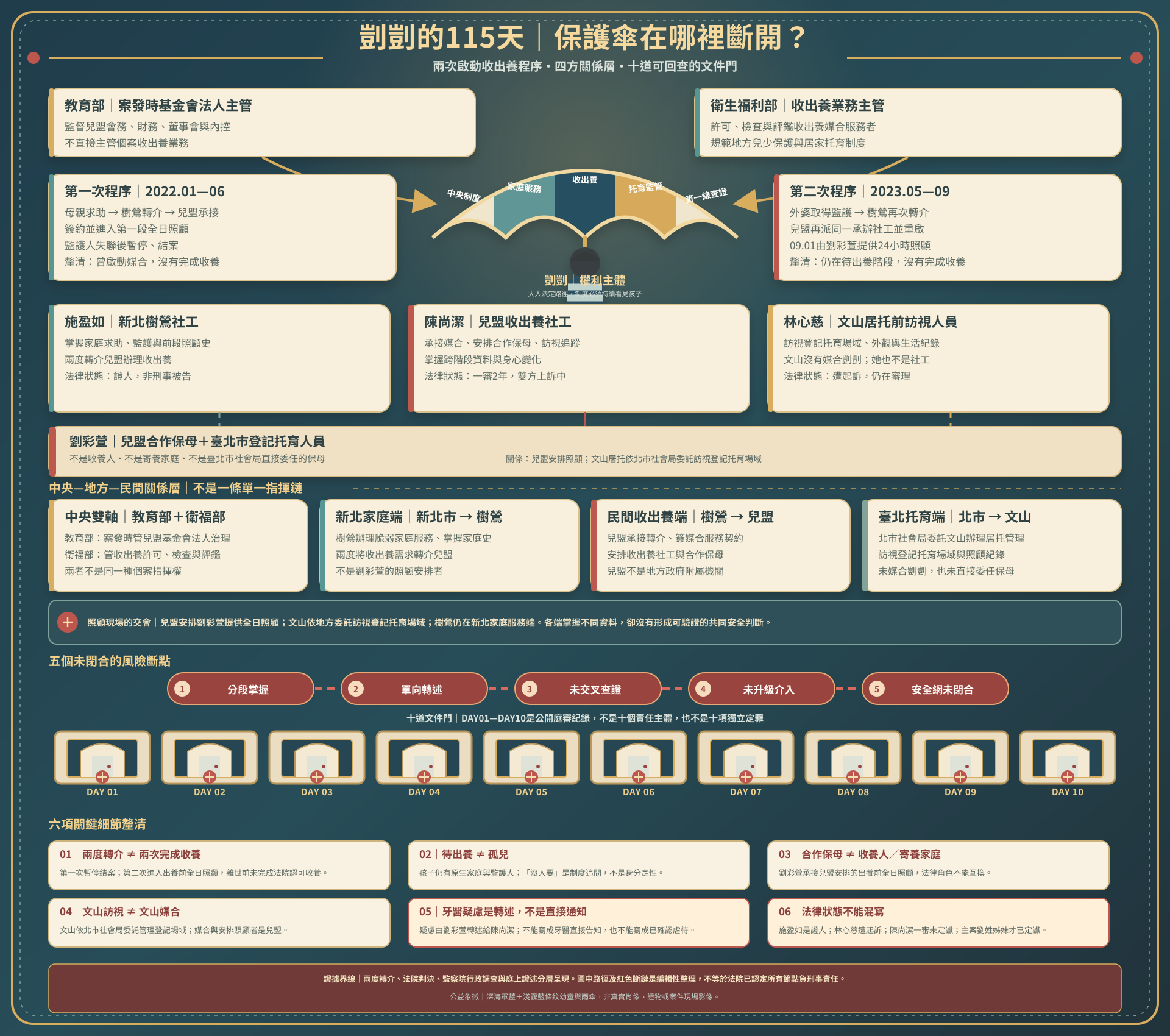
The Control Yuan examined more than one social worker or clinic. Across adoption, vulnerable families, home-based childcare, medical identification and cross-city information flows, it identified simultaneous failures in multiple systems.
Formal outcome
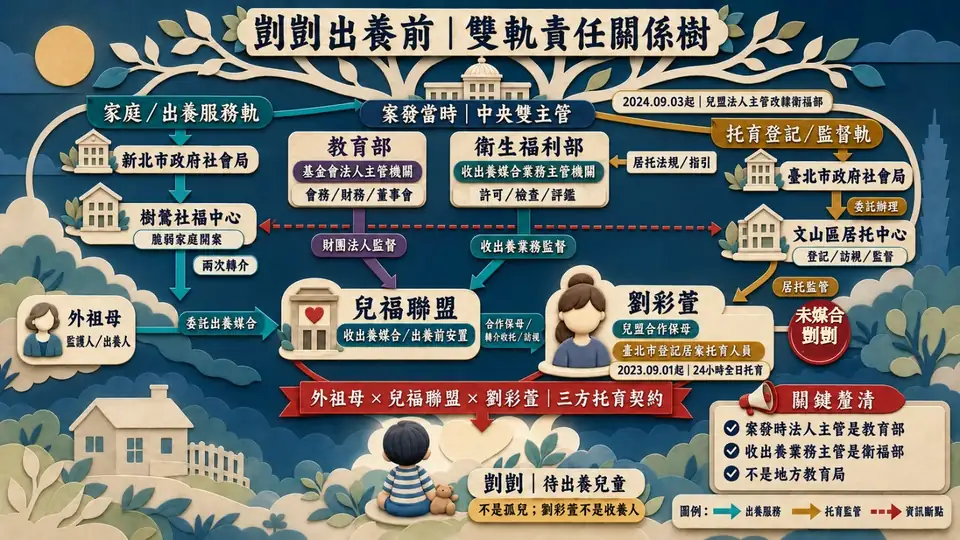
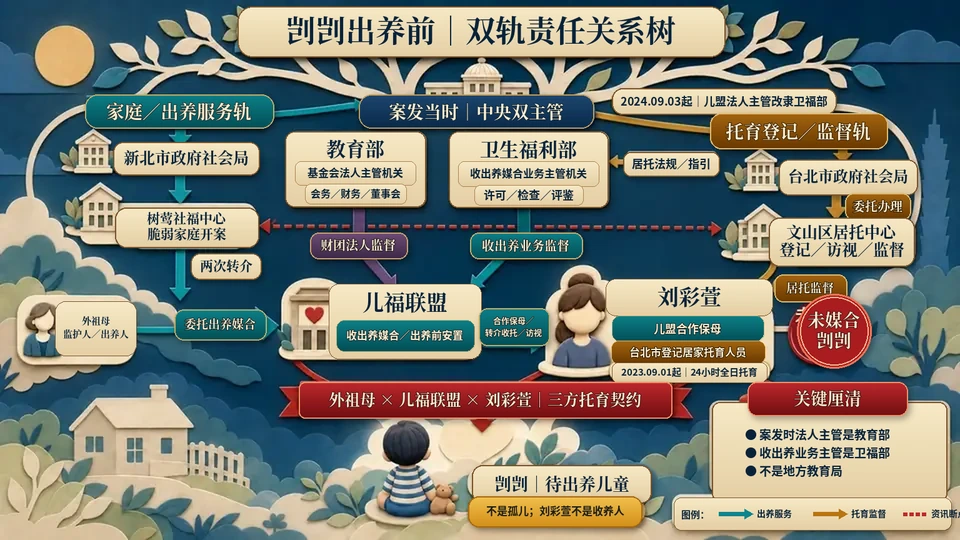
Control Yuan corrective action againstthe Ministry of Health and Welfare, New Taipei City Government and Taipei City GovernmentIt required action against derelict personnel in both city governments, and referred CWLF social-worker failings to judicial authorities for consideration. The report also notes that only the Ministry’s actual post-incident inspection uncovered seven categories of CWLF service-process and mechanism deficiencies, showing earlier inspections and evaluations failed to identify real problems in time.
CWLF social worker
Only three visits; no further direct sight of the child
The report says the social worker regarded the nanny as a partner, did not question her account, and interpreted bruises, thinness, quiet listlessness and tooth loss as poor adjustment, lacking sensitivity to the child’s best interests and abuse identification.
CWLF’s system
Gaps in nanny management, training and supervision
CWLF supervision was easily shaped by issues social workers chose to present. The Ministry’s seven post-incident deficiency categories spanned adoption necessity, placement quality, outside opinions, social-worker training, supervision and corporate internal controls.
Public sector
Three oversight systems failed to form one lead with multiple supporting agencies
New Taipei vulnerable-family services, Taipei home-based childcare oversight and Ministry adoption regulation each had authority, but lacked cross-system contact, information sharing and a completed process jointly confirming the child’s safety.
Medical providers
Abnormal tooth loss did not become a child-protection report
The report found three lost baby teeth and a large oral ulcer in a one-year-old clearly abnormal. Although providers recommended a major hospital, they did not sensitively recognize the risk of adult-inflicted force and report promptly.
Two initiated adoption procedures, not two completed adoptions
The full Control Yuan report precisely says “referred to CWLF twice for adoption-matching services.” The first was suspended and closed after loss of contact with the guardian; the second restarted after the grandmother obtained guardianship. Public information shows no court-approved adoption completed before 剴剴 died.
First procedure
2022.01—06
Started after the mother sought help; suspended when the guardian became unreachable
The mother told New Taipei’s Shuying Social Welfare Center she could not raise the child and wanted adoption; Shuying opened a vulnerable-family service case.
Shuying simultaneously referred to several Ministry-licensed matching providers; CWLF accepted and assigned a social worker.
The mother first signed an adoption-service contract, then a three-party family-childcare contract with a CWLF nanny and CWLF; the child entered his first period of round-the-clock care.
Because the mother remained guardian and could not be reached, adoption was suspended. The grandmother took the child back, found nanny 周, and CWLF then closed the case.
Second procedure
2023.05—09
Restarted after guardianship changed; the same social worker took the case again
The grandmother completed the guardianship change, gaining legal standing to handle adoption for the child.
Shuying referred the child to CWLF again, which reopened the case and “assigned the same social worker again.”
The CWLF social worker helped the grandmother sign an adoption-matching contract, formally advancing the second procedure.
The grandmother, CWLF’s cooperating nanny 劉彩萱 and CWLF signed a three-party family-childcare contract; 剴剴 entered 24-hour care.
HOW CHEN SHANGJIE ENTERED THE CASE
How is 陳尚潔 connected to both procedures?
The Control Yuan anonymized names but recorded “the same social worker again” for the second procedure. Taipei District Court’s first-instance release names 陳尚潔 as CWLF’s adoption social worker and says CWLF arranged 劉彩萱’s full-day care after intake. Cross-checking both official sources links the person and procedures.
01Cross-source inference: the same worker handled both
The Control Yuan did not name her; the court release names the second worker. Because the report explicitly says the second assignment used “the same social worker,” 陳尚潔’s involvement can be inferred back to the first procedure. This is cross-source inference, not direct naming by the Control Yuan.
02She held longitudinal information, not just one visit
The first-instance court considered that 陳尚潔 knew the child’s development from birth, care transitions and examination information, enabling comparison of the striking change before and after care in the 劉 home on one timeline.
03She was at the implementation point for CWLF’s nanny arrangements
The court found CWLF had substantive tools for recruitment, assessment, training, payment, visits and termination. 陳尚潔 was an important person able to enter the care setting, personally see the child and implement those protective duties.
04Family and other agencies relied heavily on her reports
The first-instance summary describes a division of duties between 陳尚潔 and Shuying social worker 施盈如, with 陳 controlling adoption-information transmission. Who is called “primary” is not the sole criterion; actual information and ability to intervene were central to the court’s assessment.
Six first-instance failures: not “not seeing,” but not verifying fully after seeing
Taipei District Court judgment 114年度訴字第51號 found 陳尚潔 guilty of negligent homicide and imposed two years’ imprisonment, acquitting her of document forgery. The case remains on appeal; the following are only first-instance findings, not final facts.
01No demand for objective support
The nanny attributed self-collision, grinding, fear and other abnormalities to the child or former nanny without photographs, video or other material. The court found corroboration was still not requested.
02No investigation of conflicting accounts
Abnormalities all arose after the move to the 劉 home, yet the nanny’s account was accepted one-sidedly and blame assigned to the child or earlier care, without checking with the former nanny.
03No confirmation of medical treatment
After repeated fevers, allergies, injuries and tooth loss, complete medical care was not urged, nor was appropriate treatment of injuries actually verified.
04No increased or unannounced visits
Visit frequency was not increased, unannounced visits and detailed daily records were not required, and examinations, photos and past visit information were not compared item by item.
05Visits allowed to be postponed repeatedly
After postponements citing power outages or other children’s illness, no deadline for seeing the child again or alternative check was established.
06No report or rescue initiated
The court considered that active verification, appropriate follow-up or reporting for intervention had a very high chance of preventing death, and thus found adequate causation between the omission and death.
Dates below come from the Control Yuan corrective document, supplemented by DAY2–DAY9 testimony on development, care and how he was seen. Counting both birth and death dates gives 672 calendar days.
Showing 12 life events
Administrative investigation
Before birth, the family had already sought institutional help
The Control Yuan corrective document records that the mother told Shuying Social Welfare Center in New Taipei she could not raise the unborn child and wanted adoption; a vulnerable-family case opened on January 28.
剴剴 is born; grandmother says she cared for him for about two months
On DAY8, the grandmother said the mother could not care for him and she herself did so for about two months. This describes the family’s initial care and its work and financial pressures.
Shuying referred to several lawful matching providers; CWLF accepted and assigned a social worker. This was the first intersection of local vulnerable-family services and centrally licensed private matching.
DAY3 records 蕭○香 confirming from documents that she cared for him May 4–June 29. She described tense infant limbs, massage and reporting, but not the later prolonged standing, self-harm or multiple injuries.
周○ described a healthy, lively child who walked, played and said simple words; grandmother said she visited more than twice monthly. The same original public passage gives both August 30 and 31 as the end date, so the one-day discrepancy is retained.
Grandmother becomes guardian; second CWLF referral
Guardianship changed to grandmother on May 8; New Taipei referred again on June 21; an adoption-matching contract was signed July 18. Legal status and care arrangements entered major transitions together.
Grandmother, the cooperating nanny and CWLF signed a three-party childcare contract. 周○ said care details were mainly passed to the social worker, with insufficient discussion with the next nanny. Grandmother said adoption required a CWLF-cooperating nanny.
Discrepancies among actual visit date, CWLF photographs and written record
The Control Yuan compared CWLF’s September 25 visit photos with Wenshan’s new-child visit record dated September 26: visible forehead bruising in the former, no abnormalities recorded in the latter. A separate 2026 indictment alleges the actual visit may have been September 22 but recorded as September 26; that allegation awaits trial. Taipei previously responded that visit frequency and location met then-current central rules and the visitor saw no abnormality.
Administrative investigationTestimony on surroundings
The child was quieter, listless and thin
The Control Yuan records the social worker observing quietness and listlessness, explained by the nanny as just waking. On DAY2, live-in caregiver Mira described standing, eating, bathing and physical changes she saw at specific times; she expressly could not confirm that formally dressed visitors were social workers.
Administrative investigationWarnings not escalated
Three to four teeth lost, yet only relayed accounts and follow-up
The nanny first reported tooth loss to the social worker; they met in a park the next day. On November 25 the nanny relayed the dentist’s possibilities of “stimulus, unequal treatment or underlying symptoms.” The Control Yuan also found providers failed to sensitively identify risks inconsistent with age and descriptions. Information reached grandmother on December 9 but did not complete a verifiable medical and protective process.
Administrative investigationNo further direct observation
Visit rescheduling requested; only remote reports followed
Citing another child’s illness, the nanny asked for a different visit date, then reported via LINE and telephone. The social worker never saw the child again. This was not “no contact,” but contact that never returned to a visit directly verifying his condition.
The citizen-judge court found the child died from hypovolemic shock amid long-term malnutrition and at least 42 abusive injuries. 劉彩萱’s life sentence and 劉若琳’s 18-year sentence became final on July 23, 2026.
After the child’s death: the case was not over; questioning the system had only begun
This timeline includes only traceable judicial, administrative and systemic events. It does not turn family grief, defendants’ later accounts or disputed material into court-confirmed facts; each item retains its legal character.
Death outcome
From emergency response to criminal investigation
After 剴剴 died in the early hours, a single care setting became a criminal case against the nanny sisters and public examination of failures in adoption, home-based care, vulnerable-family services and medical identification. Direct abuse and responsibility of other personnel/agencies must be read separately.
Administrative investigationOn-site investigation not completed
Immediate investigation planned; 劉彩萱 still giving a police statement
Taipei’s Social Welfare Department planned to send investigators upon notification, but the city’s special report says 劉彩萱 was still giving a police statement, preventing completion. This administrative arrangement does not mean police/prosecutors had searched the residence or seized evidence.
Administrative investigationAdministrative visit, not a criminal search
Department visits care premises to investigate the sisters
The city report records investigation of 劉彩萱 at the premises and 劉若琳 that same day. The setting was cluttered with a strong tobacco smell. This was administrative investigation; cited public sources do not record a police/prosecutorial warrant search there that day.
Investigation proceedingsRead administrative investigation and search separately
Prosecutors investigate both sisters; both detained
The city’s official chronology says that by the Department’s January 9 police call, 劉彩萱’s detention was known. CNA’s March report says prosecutors secured her incommunicado detention in January, then questioned 劉若琳 in February and secured detention. Later public hearings confirm police seized phones, but cited official sources give no full seizure inventory; they cannot be expanded into “police searched 劉彩萱’s home that day.”
Investigation proceedingsSearch and seizure do not equal guilt
Police and prosecutors search CWLF, 陳尚潔’s home and other places, seizing evidence
To preserve evidence, Taipei prosecutors directed Wenshan Second Precinct teams to search CWLF, 陳尚潔’s residence and elsewhere, seizing phones, computer towers and work documents. This investigated visit records and related responsibility, distinct from the December 26 administrative visit; search or seizure alone proves nobody guilty.
Health/Welfare and Education ministries inspect CWLF and find seven systemic deficiencies
The Control Yuan corrective document says the ministries’ joint post-incident inspection found seven deficiencies: adoption-necessity assessment, pre-adoption placement quality, external joint decisions, family support, training, supervision and corporate internal control. This reviewed institutional processes administratively, not equating CWLF or all staff with criminal defendants.
Prosecutors indict 劉彩萱 and 劉若琳; principal case goes to citizen judges
Taipei prosecutors indicted both nannies on suspected child abuse causing death, deprivation of liberty with abuse causing death, and injury causing death. This is the formal indictment of the principal case; later trial, appeal and finality are presented according to each decision stage.
Home-based visits now prioritize no appointment, varying times and seeing children personally
The Ministry adopted home-based childcare center visit guidelines centered on unannounced visits, varying times and personally seeing children, with more visits for full-day/night care and under-threes. This is a verifiable post-incident change, not a guarantee of every visit’s quality.
Clearer principles for home-based carers serving out-of-home placement children
The Ministry revised local-government principles for using home-based carers for out-of-home placements. Where “childcare” is substantively long-term substitute care, as for 剴剴, the focus is no longer merely a contract’s existence but whether interagency information, direct sight and risk escalation actually connect through completion.
Taipei District Court sentenced 劉彩萱 to life and 劉若琳 to 18 years. This direct-abuse judgment must not be merged into one legal conclusion with social-worker, home-based visitor or administrative-agency responsibility.
Control Yuan corrects Ministry, New Taipei and Taipei
Reviewing adoption oversight, vulnerable-family services, home-based childcare management and cross-city information flows, the Control Yuan corrected three government agencies and referred CWLF worker-failing materials to judicial authorities. These administrative conclusions use different proof standards from individual criminal cases.
陳尚潔 first instance: two years for negligent homicide
Taipei District Court found specific protective duties and guarantor status in this case, sentencing 陳尚潔 to two years for negligent homicide and acquitting document forgery. Both sides appealed; we say only “first-instance judgment,” without deciding second or third instance in advance.
The Supreme Court dismissed appeals, maintaining life for 劉彩萱 and 18 years for 劉若琳. Only the direct-abuse principal case became final; other criminal proceedings along the care pathway and implementation of administrative improvements need separate tracking.
The last day: what testimony can and cannot reconstruct
Not a minute-by-minute reenactment or invented additions to the case file. We align court-established time boundaries, public hearing fragments and medical mechanisms, labeling each step’s evidentiary strength.
Defendant’s courtroom answer
Already reduced activity
On DAY9 prosecutors asked whether 劉彩萱 had told counsel Child A was “less active after noon”; she answered yes. This supports an obvious afternoon change but remains a defendant’s answer, not continuous medical monitoring.
The first-instance release sets the period of joint abuse, injury and liberty restriction through about 10 p.m. December 23. An endpoint of a period does not mean a specific act was publicly established at exactly 10 p.m.
DAY1 public notes contain December 23 messages “no heartbeat” / “keep trying to save him.” Undisputed matters record 劉彩萱’s spouse performing CPR and calling 119. This establishes response after crisis, not the complete events before cardiac arrest.
The court found prolonged malnutrition, weakness and at least 42 abusive injuries ultimately caused inadequate tissue/cellular blood perfusion and hypovolemic shock. DAY5 physicians explained cumulative mechanisms involving deep bleeding, edema, restraints, prolonged standing and nutrition.
Not “healthy before a sudden accident” on the final day
Before the last day, long-term physical harm, malnutrition, weakness, psychological trauma and failure to seek active treatment had accumulated. Reduced activity and shock were the end of that cumulative injury chain.
Reasonable inference | Not minute-by-minute court findings
The rescue window began at least before loss of heartbeat
Reduced activity after noon and later response records only after no heartbeat reasonably suggest deterioration did not start at hospital transport. Earlier full assessment and care might have offered different rescue opportunities, but public sources cannot quantify chances or identify the last reversible minute.
Cannot be concluded
Do not invent a final-day abuse script
Available public material cannot establish the last meal, last injury event, each injury’s timing, minute-by-minute presence, exact cardiac-arrest onset or which defendant performed which action in the final hours.
04 · NON-GRAPHIC WHOLE-BODY EVIDENCE MAP
Whole-body injuries: at least 42 is a confirmed minimum, not the total
Based on DAY5 public hearing accounts of Dr. 呂立 and forensic physician 許倬憲. The diagram marks body regions, not realistic wounds. One region may contain multiple injuries of different ages; healed, invisible injuries are not included in “at least 42.”
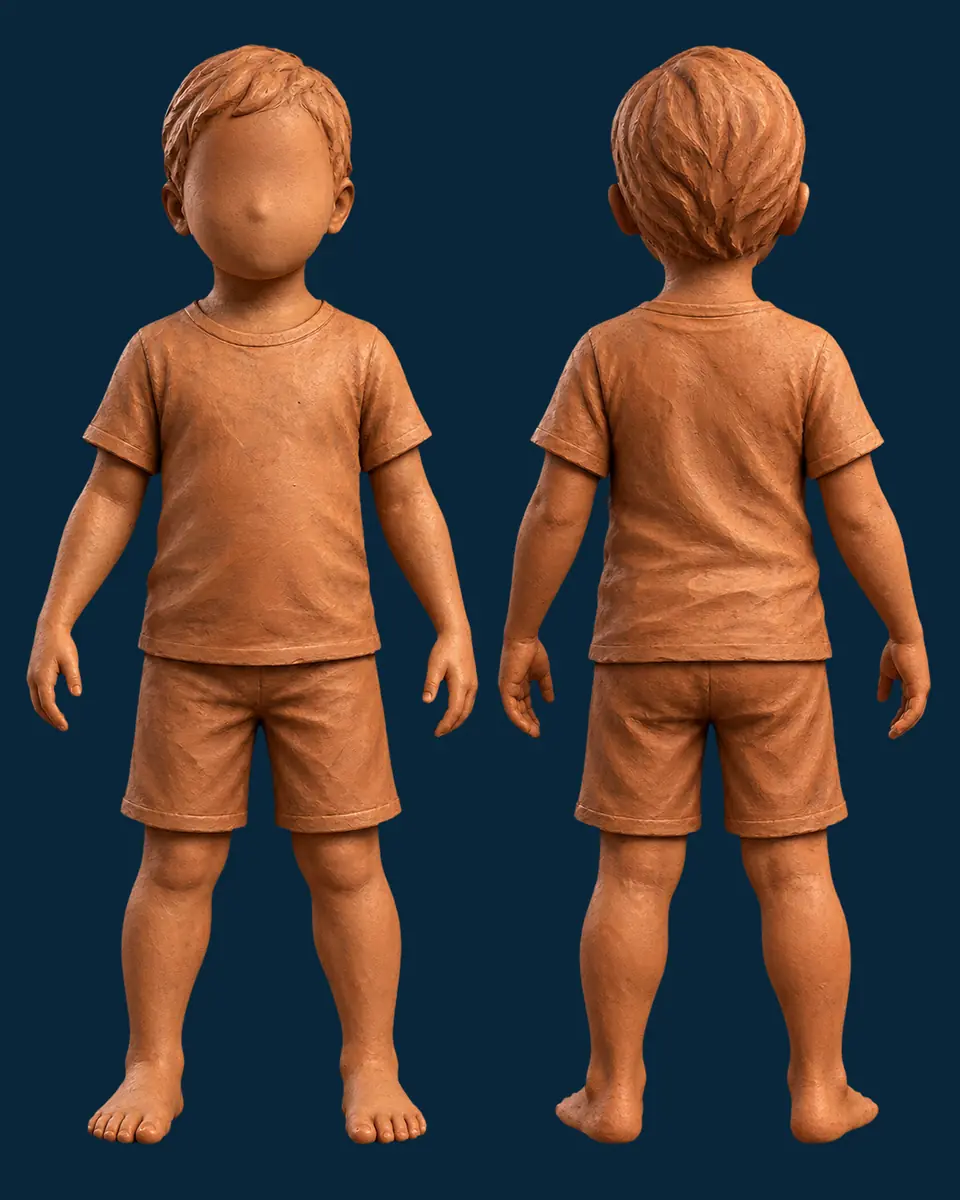
BODY REGION MAPCombined front/back location diagramNumbers mark reading areas, not injury counts, size or severity ranking
FrontBack1234567Clay-art diagram of 剴剴’s whole-body injury regionsFront/back clay child figures mark seven areas: head/face, mouth/teeth, neck/shoulders/trunk, arms/hands, abdomen, buttocks/genitals and legs/feet. No wounds are shown.
The clay figure is neither a wound photograph nor a scale reconstruction. Numbers and artwork only help readers understand whole-body, multi-region, cumulative medical evidence.
01
Scalp, forehead, eye sockets, ears and face
Bleeding in both frontal scalp areas and multiple subcutaneous scalp hemorrhages; forehead bruising, an entirely bruised left eyelid, injuries to both ears including inner auricles, cheek ligature marks and severe injuries beside both nostrils. Doctors considered several locations/patterns inconsistent with ordinary accidents or simple self-collision.
02
Lips, mucosa and teeth
Bruised lips, left mouth-corner laceration and severe damage to upper gums, frenulum and mouth-corner mucosa. PMCT showed three lower incisors fractured and one lost with its root, plus fracture traces covered by regrown gum. Doctors excluded decay and grinding as causes of this outcome.
03
Neck, left shoulder, chest, abdomen and back
Large neck bruises and scratches and extensive left-shoulder bruising; imaging showed a left scapular coracoid fracture. The forensic physician also recorded superficial skin bruises on neck, chest, abdomen and back, but no body-cavity hemorrhage.
04
Forearms, palms, fingers and deep tissues
Both upper limbs were bruised. Deep injuries from right palm to fingers involved subcutaneous tissue and nail grooves and were attributed to major force. Some left-forearm injuries may relate to resuscitation IVs, but IVs cannot explain the rest fully.
05
Abdomen and overall nutrition
Left lower abdominal bruising: doctors noted the soft abdomen and bones behind it mean considerable force is needed for bleeding/bruising there. Photos and growth charts also show chronic malnutrition, falling weight/height bands, prominent ribs and thinness.
06
Buttocks and genitals
Lower buttock folds were considered a malnutrition sign. Old/new scars, scratches and deep lacerations affected the left scrotum and genitals. Expert opinion classified high suspicion of sexual abuse while expressly noting it need not carry sexual meaning.
07
Legs, ankles and soles
Dissection measured an approximately 13-cm right-leg bruise. Ankle swelling better fits restraint/prolonged standing. Sole injuries could not be distinguished as restraint or beating; common accidental sites such as shins instead had less evident marks.
Σ
Systemic consequences: bleeding, edema, fluid shifts and shock
The forensic physician linked bleeding, edema and soft-tissue fluid accumulation from force, restraint and standing to depleted intravascular fluid, reduced organ perfusion and hypovolemic shock. Malnutrition reduced resilience; two expert reports phrase its ranking among causes somewhat differently.
WHY CAN A STARVING CHILD LOOK BLOATED?
Why could a severely wasted child’s abdomen look distended at one point?
“Looks like a famine child” is a visual analogy, not a diagnosis. Photos show different stages on different dates; one image cannot fix the entire illness course to one appearance.
Courtroom observations in this case
December 3: belly still distended; later: more wasted
Dr. 呂立 said December 3 photos already showed malnutrition: “belly still distended, face smaller, later it will sink in.” The same review described clear ribs later and loss of abdominal distension, showing appearance changes as neglect and fluid status worsen.
General medical mechanism
Low protein and oncotic pressure may move fluid outside vessels
Severe acute malnutrition can involve bilateral pitting edema. Protein/albumin deficiency may lower intravascular oncotic pressure, moving fluid into tissue or the abdomen. Edema, ascites and muscle/fat loss may make the belly relatively prominent. WHO also notes higher mortality risk in malnourished children with severe edema.
Not established in this case
Photos alone cannot diagnose kwashiorkor or ascites
DAY5 says the earlier hospital did not test albumin. Public hearings do not confirm one cause through full abdominal ultrasound, albumin, liver/kidney function and ascitic-fluid analysis. Gas, stool, posture, enlarged organs or fluid may affect appearance; one photo is not diagnostic.
Testimony puzzle: one child seen in different ways
Side-by-side dialogue boxes do not cancel testimony out; they align timing, scope and evidence limits. Text faithfully paraphrases; see original hearings for full Q&A.
00
Reporting threshold: judge’s direct question
Judge
On the marked change in the child, the judge asked: At what point would CWLF see a duty to report? Must it wait for “injuries all over, broken arms and legs”?
白麗芳 | Observer-note paraphrase
Proceedings briefly paused as observers became emotional and cried. She did not answer that hypothetical directly; afterward she first cited “clear evidence” for reporting possible abuse, then acknowledged the statutory mandated-reporting threshold is “suspected” abuse or maltreatment.
01
Early baseline × later change
周○, grandmother | Early care
He could walk and play; grandmother called him healthy, lively and mischievous.
Milk amounts and other details mainly went to the social worker. She did not speak sufficiently with the next nanny, only asking her to love, cherish and hold the child more.
The former nanny saw no such behavior; forensic, child-protection and child-psychiatry physicians called for injuries, nutrition and long-term context to be read together.
Defendants’ personal circumstances, treatment motivation and reintegration conditions; does not rewrite injuries or cause of death.
06 · RELATED FIRST-INSTANCE TESTIMONY
Testimony is not isolated: who saw, relayed and failed to verify?
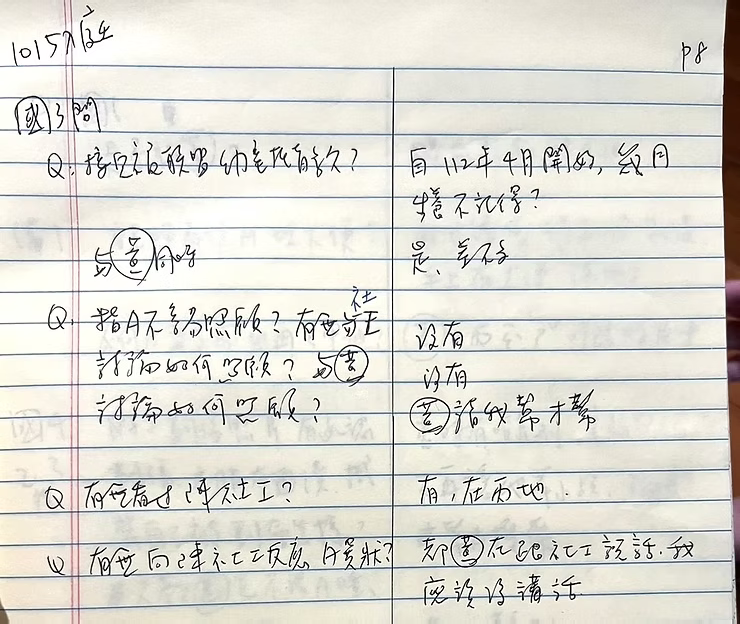
These witnesses testified in a separate case, not the principal case’s ten hearing days, and this is not a complete transcript. Public first-instance hearing summaries and court releases place witnesses’ systemic perspectives on the left and the first-instance assessment on the right.
CHEN SHANG-JIE · INDIVIDUAL ACCOUNTABILITY
陳尚潔 accountability: first-instance timeline × September 25 preparation × 12 witnesses × February 23/26 observer records
This section combines individual accountability with February 23 questioning and February 26 statements to clarify actual duties, care obligations, risk verification, reporting and possible legal liability. It integrates observer notes and media court reports, not an official transcript, separating defendant accounts, prosecution claims, witness testimony and first-instance findings passage by passage.
February 23, dark teal | Courtroom exchangesFebruary 26, dark reddish brown | Final statementYellow marks | Key remarksSidebar | Testimony issues / contradictions
FIRST-INSTANCE PROCEDURAL TIMELINE · 2024—2026
陳尚潔 first-instance hearing timeline
From indictment and initial review hearing through preparation, concentrated witness investigation and judgment, distinguishing the first hearing from the first intensive hearings after preparation.
Investigation ended / prosecution filed
Taipei prosecutors indict for suspected negligent homicide, forgery and other offenses
After investigating, prosecutors filed with Taipei District Court and sought a severe sentence; the case moved from investigation to first instance.
First review hearing
First Taipei hearing; 陳尚潔 pleads not guilty
陳 denied forging visit records and other allegations; the court barred departure from Taiwan by air/land or sea that day. This was the first first-instance hearing.
Continued preparation / hearing
Further hearing; defense and duty scope remain contested
陳 maintained her not-guilty position; defense claimed indictment duties differed from actual responsibilities.
Preparatory proceedings
Organizing defenses, evidence and subsequent issues
陳 said she was not the primary social worker and saw no special injuries requiring reporting during visits. The court scheduled final issue organization for September 25.
Fourth and final preparatory hearing
Confirm issues, 11 witnesses and intensive hearing dates
The court organized disputed/undisputed matters: prosecution requested eight witnesses, defense three, and both sides confirmed no settlement consensus.
First intensive post-preparation hearing / witness examination
Not the first first-instance hearing; correctly, the key start of intensive evidence investigation and witness questioning after preparation ended.
Hearing span for 12 witnesses
Five dates complete observer records for 12 witnesses
Hearings on 2025.11.27, 12.11, 12.18 and 2026.01.22, 01.29 progressively addressed primary roles, well-being follow-up, record timeliness, medical warnings and organizational division.
Fourth and final first-instance preparatory hearing | Complete public-record reconstruction
Two-hour preparation: issues, 11 witnesses, settlement positions and future dates
01Hearing and procedural positionExpand / Collapse01
Hearing and procedural position
Taipei District Court held the fourth and final preparatory hearing on the afternoon of September 25, 2025, lasting about two hours until around 4 p.m. It completed outstanding preparation and organized the scope of substantive trial.
This was preparatory, not formal witness testimony, full defendant questioning, closing arguments or judgment.
Public reports say 陳 continued denying crime, saying she was neither primary social worker nor holder of public authority. Defense disputed alleged duties, ongoing monitoring/supervision and the legal link between alleged failures and death.
03Judge organizes disputed and undisputed mattersExpand / Collapse03
Judge organizes disputed and undisputed matters
The judge, prosecutor and counsel organized disputed/undisputed matters, needed evidence, witness necessity and unresolved questions. Reports identify actual roles in adoption/care, continuing follow-up duties, record completion/modification and the legal link between warning handling and death as central.
Prosecution sought four current CWLF workers/managers, two public social-welfare personnel, one Social and Family Affairs Administration official and one resuscitation physician. Reports confirm Dr. 黃聖心, Wenshan childcare supervisor 黃玲芳 and CWLF personnel among them.
They sought to clarify whether 陳 handled the adoption case, failed statutory continuing follow-up, missed record deadlines, and issues of record content and subjective awareness.
05Defense requests three witnessesExpand / Collapse05
Defense requests three witnesses
Defense sought then-CWLF executive director 白麗芳, dentist 蔡函妤 and former Wenshan visitor 林心慈 to clarify record deadlines after visits, legal bases, duties and other rebuttal matters. It questioned possible interests of some public-sector witnesses and asked the court to consider necessity.
06Dispute over necessity of dentist testimonyExpand / Collapse06
Dispute over necessity of dentist testimony
Family counsel said 蔡 saw the child only once, with limited relevance to 陳’s continuing follow-up. Prosecutors questioned whether she knew injuries elsewhere; defense listed her for rebuttal to clarify examination, referral and communications.
07Checking willingness to settleExpand / Collapse07
Checking willingness to settle
The judge asked both sides about settlement. Reports say 陳 was unwilling to discuss it; grandmother’s lawyer said because 陳 denied guilt and had already declined, the family also did not wish to reopen talks.
That was the September 25, 2025 courtroom position; later judgment reasons govern its sentencing assessment.
08Court schedules later hearingsExpand / Collapse08
Court schedules later hearings
At the end, the court scheduled intensive hearings. Sources differ slightly: TVBS lists October 23, November 13 and 27, December 4; 知新聞 and same-day public records also list November 6. We display both without editing either away.
The later 12-witness full-text page uses actual observer-note hearing dates, November 27, 2025–January 29, 2026.
Defendant examination summary
The court asked not about titles, but why known warnings prompted no further check
01Dental-room video and admissibilityExpand / Collapse01
Dental-room video and admissibility
Court inspection:November 23, 2023 clinic footage shows the caregiver citing grinding for lost teeth; the dentist considered multiple baby teeth falling out that way extremely unlikely and recommended major-hospital examination and follow-up. Prosecutors noted low responsiveness; defense stressed an active caregiver and no obvious exposed injuries.
Prosecution/defense dispute:Prosecutors claimed some records conflicted with objective evidence; defense contested intent, hearsay and interrogation methods, while the panel assessed inspection necessity item by item.
02Education, experience, caseload and abuse trainingExpand / Collapse02
Education, experience, caseload and abuse training
Prosecution asks:What are 陳’s adoption experience, caseload and child-abuse identification training?
陳尚潔 answers:She worked in adoption long after graduation, including at Chung Yi Foundation with its own placement facility. CWLF abuse courses were introductory and did not enable social workers to diagnose like doctors.
Key: Is responsibility medical diagnosis, or verification, referral and reporting after warnings?
03Care selection: not her sole decision, but she participatedExpand / Collapse03
Care selection: not her sole decision, but she participated
Judge asks:Among about ten cooperating nannies, how was 劉彩萱 selected? Did distance matter?
陳尚潔 answers:Supervisors and meetings jointly assessed, not she alone. She supplied needs such as more developmental stimulation. 劉 had preschool experience, teaching aids and developmental knowledge; distance was not primary.
Judge confirms:So “everyone” jointly choosing included her? She said she participated in discussing case needs.
Key: Denying sole decision-making does not deny assessment participation; responsibility follows actual information and available action.
04What should the three visits examine?Expand / Collapse04
What should the three visits examine?
Prosecution asks:What were the aims and contents of September–November’s three visits?
陳尚潔 answers:Understand health/development with the caregiver, get to know the child and build rapport; usually about an hour.
Judge follows up:Did every visit really last an hour? She first said “probably,” then confirmed by her work habits.
Key: Formal duration cannot replace substantive checking of injuries, nutrition, mental state and medical results.
05Self-collision, swearing and former-nanny trauma accountExpand / Collapse05
Self-collision, swearing and former-nanny trauma account
Prosecution asks:Did 陳 personally see claimed self-collision/falls, hanger fear, grinding or swearing during visits?
陳尚潔 answers:She did not directly observe them but thought them possible. She asked the former nanny through 施; despite denial, she supposed caring for several children might have caused missed abnormalities.
Key: Not personally seen and denied by former nanny, yet new caregiver’s one-sided explanation accepted.
06Delayed photos, phone repair and missing recordsExpand / Collapse06
Delayed photos, phone repair and missing records
Prosecution asks:Why no reply to grandmother’s October 6 photo request, only sending September 25/October 23 photos together on October 24, with no result in work records?
陳尚潔 answers:Her phone was under repair. She remembered calling grandmother and supervisor and thought she recorded follow-up; if absent, a busy omission, with no reason to hide deliberately.
Prosecution follows up:Do records need only actions, not results? She denied that and said results should also be recorded.
Key: Notes show not just delayed photos, but when replies occurred and whether auditable results were recorded.
07Tooth loss, referral and 24-hour reportingExpand / Collapse07
Tooth loss, referral and 24-hour reporting
Prosecution asks:After hearing a fourth tooth was lost through “biting and grinding,” and the dentist raised maltreatment concerns and requested hospital checks, why no accompaniment, referral confirmation or report?
陳尚潔 answers:She discussed with teammates, all surprised. She thought the nanny clear-spoken, so accompaniment unnecessary. Considering the caregiver’s account, she judged the threshold unmet and trusted anyone in the safety net suspecting abuse would report.
Key: Using others’ ability to report as reason not to report is central to collective safety-net failure.
08Fever, bruising and medical follow-upExpand / Collapse08
Fever, bruising and medical follow-up
Judge asks:For September’s large forehead bruise, was ointment used, intracranial injury checked or medical care followed?
陳尚潔 answers:She asked the nanny; he seemed not especially unwell and bruising would heal slowly.
Judge asks again:After November fever prevented vaccination, was recovery/catch-up followed? She said views on fever vary and it might improve resistance.
Judge: Why do caregivers’ premises always lead her to conclusions different from ordinary risk assessment?
09Growth gap and sharp fall in medical visitsExpand / Collapse09
Growth gap and sharp fall in medical visits
Prosecution presents:Normal height/weight before handover, no growth afterward and marked final thinness—how does defense’s “taller and slimmer” claim hold?
陳尚潔 answers:She felt he had grown taller and said health/development would be checked on the work schedule.
Judge presents:Many dermatology visits before transfer, few until death afterward; she said she did not know the earlier history.
10December visits: postponement, outdoor alternatives and play therapyExpand / Collapse10
December visits: postponement, outdoor alternatives and play therapy
Judge asks:Past visits were outdoors; when another child’s illness blocked entry around November 20 and December 20, why not briefly meet downstairs?
陳尚潔 answers:She needed about an hour of interaction and feared epidemic/cross-infection; postponed, not canceled. She discussed play therapy with 江怡韻 and 葉詩宇, with a colleague contacting an outside counselor, but arrangements were unfinished before death.
Key: Proposing follow-up ideas does not complete visits, referrals or risk escalation.
11Excel, Word and post-incident reconstruction timelineExpand / Collapse11
Excel, Word and post-incident reconstruction timeline
Prosecution asks:Was the Word record completed only after December 24? Why was the claimed Excel absent from seized computers and notebooks?
陳尚潔 answers:She first kept material in Excel, messages, phone notes, photos or video, then organized Word. She recalled Excel existing but could not confirm Word’s final completion date.
Timeline follow-up:When 葉詩宇 requested screenshots/visit records December 29, she said unfinished; January 8 messages still mention writing, including the November 20 visit. She said December 29 referred to complete Word, not earlier scattered material.
Judge presents:Why no comparable diary when another child’s monthly record details food, bowel movements, sleep and development? She said unmatched children use service records; full monthly growth diaries follow matching.
Boundary: Timing, sources and auditability may be scrutinized strictly, but first-instance forgery acquittal means post-incident compilation cannot simply be called deliberate falsification.
12Leave, overseas travel and work impactExpand / Collapse12
Leave, overseas travel and work impact
Judge asks:Did four leave days in September, two in October and four in November—including about a week in Japan and two weddings—delay follow-up?
陳尚潔 answers:She said leave was reasonable and did not affect work. The judge clarified the question was not denying leave to social workers, but checking actual work handover.
The issue is not leave itself but continuity of cover, records and warnings before/after it.
13Emergency accounts, cause-of-death memories and who was lyingExpand / Collapse13
Emergency accounts, cause-of-death memories and who was lying
Prosecution asks:The emergency team did not treat this as an ordinary accident. Why record a nurse saying “suspected accident”? Did staff or she misremember?
陳尚潔 answers:She recalled a doctor/nurse comforting grandmother amid chaos with words like “uncertain, possibly an accident,” recording her impression. She denied lying and acknowledged differing memories.
On arrival:After 劉’s message/call, she first contacted grandmother and supervisor, then walked from Xinglong Road home to Wanfang Hospital within about half an hour to one hour.
Boundary: Differences require original medical-record checks; first instance found insufficient evidence of knowingly false entries.
14Perineal injuries: what was known and inferred thenExpand / Collapse14
Perineal injuries: what was known and inferred then
Prosecution asks:On December 29 葉詩宇 asked whether 劉 had mentioned perineal injuries. 陳 said not directly, yet linked arm scratches, atopic dermatitis and the perineum—was she supplying excuses for the caregiver?
陳尚潔 answers:She did not yet know injury causes or perpetrator, only considered possibilities with limited information, and was not excusing anyone.
Issue: Later inferences without contemporaneous photos, diagnoses or direct statements cannot become pre-incident verified facts retroactively.
15Who does “primary” mean in the notes?Expand / Collapse15
Who does “primary” mean in the notes?
Judge asks:Who do “剴, primary” and other “primary” entries refer to?
陳尚潔 answers:All meant Shuying/government social workers and their closure dates, not her; she described herself as a cooperating adoption worker, not the formal primary worker.
Judge confirms:Even without the title, must she observe health/development and build a relationship? She said yes, describing intervention as understanding health/development and finding appropriate care for matching.
Key admission: Titles may be disputed, but she acknowledged actual health, development and relationship-building responsibilities.
16Why always choose to trust others?Expand / Collapse16
Why always choose to trust others?
Prosecution asks:What was her relationship with 劉彩萱, and why believe whatever she said?
陳尚潔 answers:Two collaborations and others’ observations portrayed 劉 as active and caring; only later did she learn the loving image was a very convincing act.
Associate judge asks:Was she easily trusting? She said perhaps somewhat. The judge noted she was a professional herself: when expertise conflicts, why always believe someone else?
Courtroom core: A safety net cannot consist of everyone trusting the next person while nobody actually catches the child.
Dark blue | ProsecutionOchre gold | JudgeLight paper | 陳尚潔
001Social worker 陳
I hoped professionals could help. I did not simply conclude the previous caregiver did these things because she said so; that was not my view. When discussing this with someone who had encountered adoption social workers or the justice system, she also offered personal assessments. My point is I did not make these decisions alone. Grandmother had authority over changing nannies, which I fully respected; I also trusted other networks and included other workers’ and doctors’ views. I discussed interventions and follow-up with my supervisor and followed institutional procedures.
002Prosecutor
Regarding the 劉 child’sservice records, did you complete them progressively only after his death on December 24, 2023?
003Social worker 陳
If you mean that Word file, yes. But my usual habit is to enter case information and interventions in an Excel sheet. That is my personal habit, so I progressively recorded according to work arrangements in Excel . But the organization’s standard form is a Word file, so when a report is needed, I organize the Excel sheet’s information into Word. Thisservice recordscontent has a basis: records accumulated continuously during my service.Word The file was indeed made after December 24, but both things are true.
004Prosecutor
Prosecutors searched CWLF and seized your work computer and notebook, correct?
005Social worker 陳
Yes. But they did not see the Excel file contents you describe. I am not sure whether they viewed all my data, but my files did exist on my computer.
006Prosecutor
Approximately when did you complete and submit the finalservice records?
007Social worker 陳
I do not quite remember now when this Word file was completed.
008Prosecutor
Next, your conversation with 葉詩宇: she requested nanny conversations or visit records, you sent a screenshot link saying “screenshots here; records… not finished,” and she said “no problem.” So as of 2023,December 29, they were still unfinished?
009Social worker 陳
Yes, not fully complete. I was still providing services, so of course still writing. The whole record was unfinished, so I did not give it to her. Screenshots seemed quicker for the information she wanted.
010Prosecutor
Shown: investigation volume 8, page 88. In 2024, onJanuary 8at 5:51 p.m., your conversation with 葉亭希 says: “Writing the child’s records these days feels agonizing; only the November 20 visit remains from before the incident; much post-incident content, still writing.” So on “November 18, 2024,” you finally finished the earlierservice records, with November 20’s visit still unwritten? How did you retrospectively recall each day of four months? [The prosecutor first cited January 8, 2024, then said “November 18, 2024”; context suggests a courtroom slip, subject to official minutes.]
011Social worker 陳
Our records have different parts. Contacts may use messaging or telephone; I make notes and refer to them. On each visit I photograph, film and make small messaging-app notes, which form the visit record.
012Prosecutor
So except for those three visit days, you reviewed conversations with 劉彩萱 and entered each day’s events in work records? That is how they were made—review conversations, organize daily content and copy it in?
013Social worker 陳
That question somewhat distorts my meaning. I did put these things in records; you call it copying, but I call it organizing. I organized the communication process into work records.
014Social worker 陳
I think this is a normal process.
015Prosecutor
Yes, I only want to confirm how you made the records.
016Social worker 陳
An ordinary person cannot recall every day of four months after an incident. I mean I organize based on conversations. If you ask whether I only started after December 24, clearly no. At each month-end I review services: sometimes record then, sometimes contact occurs outside or amid other work and cannot be recorded immediately. But I have the conversations as a basis. Monthly or as work permits I organize communications and visits into records, reviewing and consolidating regularly under the workflow.
017Prosecutor
If you did this monthly, why give 葉詩宇 only screenshots when she requested visit records?
018Social worker 陳
Because I had not finished. As I said, I organized it in Excel , but perhaps I was rigid in thinking she wanted a complete Word version, which was unfinished.
019Prosecutor
You attended the prosecutor’s December 24, 2023 examination of the body, correct? You were not questioned. Attachment 26, page 21 records it. At the end the prosecutor invited everyone into the examination room. The forensic physician explained injuries all over: head, legs, both hands, back, thighs, knees, lower legs, including genital abrasions/contusions. Death might relate to them; which was fatal required results. You heard this. Wanfang staff also testified no team member thought it accidental or would say so. Why, when later completingservice records, did you still write “Nurse said caused bysuspected accident”?
020Social worker 陳
First, I did know some information on December 24. As asked earlier, I recorded doctors’ information. At the hospital, a doctor mentioned this while my supervisor and I accompanied grandmother. My impression was comforting family, not making a judgment. I recorded that impression because I heard it. I had no need to lie.
021Prosecutor
First, did you know these conditions then? As asked before, how did you know?
022Social worker 陳
I knew that information then and recorded what doctors gave me, as counsel said. A doctor explained the child’s condition while we accompanied grandmother; I recall recording it. Yes, I knew. Later a female doctor mentioned this while explaining, but it was not her focus. I understood she was comforting grandmother, saying machine support was hard on him and ultimately the machine was stopped. In a comforting tone she said “cause uncertain, perhaps an accident.” That fragment stayed with me from emergency care. Later I understood it may have been retelling or comfort, not professional judgment. At the time I heard it and recorded it; I am not a doctor and cannot determine true cause of death, only record impressions.
023Prosecutor
To confirm: did a doctor or nurse actually tell grandmother at the scene, “The 劉 child’ssuspected accidentcaused death”? Yes or no?
024Social worker 陳
There was such a person. As described, they mentioned it in explaining; that is my impression. I hid nothing, only recorded memorable parts of that long night. Yet doctor or nurse, even Dr. 黃 who later testified, said they had not said it.
025Prosecutor
So is the doctor lying, or are you?
026Social worker 陳
First, I am not lying. Without that impression I would not write it. I have no need to fabricate, only record remembered experience. Time has passed; doctors see many patients and may not recall saying it that day. Later he also said “perhaps I might have said that.” It is uncertain. I recorded my impression, emphasizing I had no reason to lie and truly remembered it. With time, everyone’s memories may be unclear.
027Prosecutor
Let me ask this way: were you writing that to say even the nurse could not tell?
028Social worker 陳
That was not what I meant.
029Prosecutor
Shown: investigation volume 9, page 136. In your conversation, 葉詩宇 asked onDecember 29: “Did 劉彩萱 mention in messages theperineuminjuries?” You replied: “She did not directly mention it, but when I visited there were obvious arm wounds, which they called self-scratching. I recall atopic dermatitis being mentioned, making joints itchy, so theperineumshould count in that category.” You specifically added in parentheses, “She did not directly sayperineum.” Can the child’s injuries be fitted to 劉’s excuses that way? Are you finding excuses for her or annotating them?
030Social worker 陳
I must restore the context. Although present on December 24, hearing explanations and seeing things, untilDecember 29I still did not know what happened or who caused it. Only after January did we learn the nanny herself had done many terrible things. But onDecember 29I truly did not know the truth. When a colleague asked, I recalled received information and considered possibilities. These were recollections and thoughts, not judgments or conclusions I could make.
031Prosecutor
How exactly did you assess the 劉 child’s growth? What concrete method?
032Social worker 陳
I observed during visits and asked the nanny about daily care and observed development. A one-hour visit cannot reveal every aspect, so we rely heavily on caregivers’ help assessing and observing. Other workers, including childcare visitors, also ask caregivers and observe care. I used that method and recorded it.
033Prosecutor
So you mean you usedservice recordsinstead of baby growth records? But thisservice recordswas only gradually written afterward based on your so-called Excel file. CWLF says it should have been submitted before the incident, not merely written monthly. What does that amount to?
034Social worker 陳
I disagree. Information was noted or recorded monthly; only the complete report was not submitted beforehand. This entireservice recordswas recorded when I obtained information and genuinely concerns that month. We put it in work records to see changes and the child’s condition throughout the process.
035Prosecutor
On October 6, 2023 you messaged 劉彩萱 requesting photos, correct?
036Social worker 陳
Correct.
037Prosecutor
Did she respond?
038Social worker 陳
No.
039Prosecutor
How did she reply later?
040Social worker 陳
Days later she said she had not replied because herphone was being repaired。
041Prosecutor
So you got no photos from 劉 then, correct?
042Social worker 陳
Yes.
043Prosecutor
Then why does yourservice recordsnot say “nanny did not supply them because ofphone was being repaired”?
044Social worker 陳
I checked conversations but summarized key points. I thought the service process mattered, not her failure to provide photos.
045Prosecutor
So showing what you did is enough and results do not matter?
046Social worker 陳
No. If she provided them, I would write that she did.
047Prosecutor
Did you wait until 2023,October 24, to send grandmother your September 25 and October visit photos together?
048Social worker 陳
Correct.
049Prosecutor
Shown: investigation volume 14, page 14, the defendant’sservice records. In October’sservice records, why is there no entry that onOctober 24you sent grandmother the September 25 and October 23 visit photos together? Omitted to avoid worrying her? Why not record sending them?
050Social worker 陳
That is a good question. I always thought I had written it and later found I had not. I am not quibbling: I did it, and omission harms me, so I had no reason deliberately not to write it. It must have been missed in organizing.October 24, I not only sent photos to grandmother but called her and the supervising social worker. None of this was recorded inOctober 24records, puzzling me because it was important. Thank you for the reminder, prosecutor. I truly did these things but do not know why the record omitted them.
051Prosecutor
But didn't you say you gradually filled it in after the incident? With conversation records to consult, why were things still omitted? Did you write unimportant things and miss the important ones? What exactly were you trying to conceal?
052Social worker 陳
I think this shows I knew it was important and wanted to include it. I used not only conversation records but my own notes. In theory it should have been written, but it did not appear in the completed record. I still do not know why it was omitted, but I can imagine the circumstances: I was writing records while handling contact with the grandmother and other cases. I contacted her almost every day then, especially December 26–27. I mean I was writing and handling many things simultaneously. It was chaotic, so I remain puzzled why it was not in the record. I had no reason to omit it deliberately; I can only infer that I missed it because I was too busy.
053Prosecutor
One final question: after the entire investigation and trial, do you still not know what you are doing?
054Social worker 陳
That has never been what I meant. I have never said during these proceedings, ‘I do not know what I am doing.’ I have been trying to explain that I am an adoption social worker, so my responsibilities and duties are those of an adoption social worker. I know this is my work and responsibility.
055Male judge
Ms. 陳, who notified you on the incident date that the child 劉 was taken for emergency treatment?
056Social worker 陳
Let me reconstruct what happened. I received a message from 劉彩萱, and she also called me.
057Male judge
How long after notification did you reach the hospital? Hospital records suggest half an hour to an hour. Do you remember how you got there? Did you walk from home? Where were you living?
058Social worker 陳
I lived on Xinlong Road and walked from home to Wanfang Hospital.
059Male judge
So not your current address. To confirm, you had worked with 劉彩萱 before this case?
060Social worker 陳
Yes. Sorry, may I add to the previous answer? The presiding judge asked how long it took to reach Wanfang Hospital, and I said about half an hour to an hour. When I received the message, I first knew I needed to contact the guardian, so I dealt with that. Only afterward did 劉彩萱 say she wanted me at the hospital. I could not decide that alone, so I spent some more time checking with my supervisor before going.
061Male judge
So you walked from your Xinlong Road home to Wanfang Hospital. You said you had worked with the caregiver once before. Did you decide to work with her then?
062Social worker 陳
No. I do not decide caregiver assignments. The manager responsible for caregiver services arranges them according to circumstances. Sometimes we meet to discuss which children need childcare, which caregivers have vacancies and suitable arrangements.
063Male judge
So it is decided in meetings? Do you express opinions there?
064Social worker 陳
We explain the case and discuss it together. But I did not specifically request any particular caregiver for this child.
065Male judge
So you cannot express any opinion?
066Social worker 陳
I mean we explain the child's circumstances and discuss suitable types of caregiver. This child was over one year old and might need more developmental stimulation. Some caregivers are better with children aged zero to one, others with older children. I mentioned his age to discuss suitability, not a particular caregiver.
067Male judge
So you did not mean caregiver 周?
068Social worker 陳
No.
069Male judge
So you expressed no opinion on which caregiver to select in this case?
070Social worker 陳
As I said, we discussed it in meetings, but only the registered list of caregivers. I was not the person deciding among them. Caregiver arrangements are the manager's work.
071Male judge
Who was on the list then?
072Social worker 陳
One page in the evidence list mentions about ten people. Several children needed arrangements then. Younger ones went to caregivers skilled with ages zero to one. 劉彩萱 had kindergarten experience, teaching materials at home, and some expertise in parenting approaches and child development, so the group assessment found her suitable for children over one.
073Male judge
Do you mean everyone independently reached the same decision?
074Social worker 陳
It was the result of joint discussion.
075Male judge
‘Everyone’ includes you. Was 劉彩萱 chosen because her home was particularly close to yours?
076Social worker 陳
No. Distance was not a factor in deciding suitability.
077Male judge
If someone at the caregiver's home was ill and a home visit was impossible, could she not bring the child downstairs for you to see?
078Social worker 陳
No. Visits are meant to allow proper discussion and interaction with the child. We usually set aside an hour. After the pandemic everyone was more cautious about health, so illness meant rescheduling.
079Male judge
Have you ever substituted an outdoor visit for a home visit in other cases?
080Social worker 陳
Yes.
081Male judge
Why were visits also held in a park in this case? Why were visits not arranged on November 20 and December 20?
082Social worker 陳
It was not a refusal to arrange visits. The caregiver said another child had health issues to handle. With greater caution about illness after the pandemic, we temporarily did not schedule one. It was a postponement, not abandoning visits.
083Male judge
So the caregiver mentioned a child's health problem?
084Social worker 陳
She meant another child. But she cared for both children, so it affected 劉's care too.
085Male judge
At the November outdoor visit, did she bring both children downstairs?
086Social worker 陳
Yes.
087Male judge
Sorry, when the prosecutor asked about preparing casework records, you said there were Excel files, text files and paper notes. Let me confirm: your working materials included Excel files and some paper notes? Or only computer files?
088Social worker 陳
I am a little unclear about the paper ones now. Sometimes I wrote in notes at hand but may not have kept them afterward. All my materials were taken in December 2024 [date as recorded in observer notes; still subject to verification against the official record], so they are all in there.
089Male judge
Who suggested the eventual decision to provide play therapy for the child?
090Social worker 陳
After supervisor 江怡韻 and I discussed the child's situation, she discussed it with manager 葉亭希.
091Male judge
The conversation shown by the prosecutor involved you and someone named 謝凱婷. Who is she?
092Social worker 陳
A colleague.
093Male judge
Is she still there?
094Social worker 陳
I am not sure. Probably, but I do not know current staffing.
095Male judge
The messages suggest you asked about teeth grinding and 謝凱婷 asked someone named 宜靜. Who is 宜靜?
096Social worker 陳
A counselor at an outside practice, not our organization. She had served other children of ours, so supervisor 謝 asked her. The message mentioned calling me when available and that she had some views.
097Male judge
Did you speak by phone afterward? What did she say?
098Social worker 陳
I do not clearly remember details. Roughly, she agreed the circumstances were unusual and was very willing to help. Counseling required the caregiver's assistance, so she discussed possible arrangements with me.
099Male judge
Play therapy also requires the caregiver's assistance, doesn't it? Why was it not arranged afterward?
100Social worker 陳
I had prepared this information to discuss with 劉彩萱, but had not yet had the chance.
101Male judge
What exactly did supervisor 謝 say when she later called you?
102Social worker 陳
I remember she broadly said everyone needed to cooperate. I am unclear on the details.
103Male judge
Another question: during 劉彩萱's care, mainly September 1 to December 24, you said you had about a dozen cases. Apart from official duties, did any personal matters affect your work over those three-plus months?
104Social worker 陳
My personal affairs do not affect work. I arrange them around the pace of work.
105Male judge
Your calendar shows four days' leave in September, two in October and four in November. Leave seems relatively frequent, including one full week. What was the situation?
106Social worker 陳
I think the judge wants to know whether anything particular affected work. Some leave was for follow-up appointments, some for illness and rest, and some private plans. All were reasonable and did not prevent work completion. I later realized I needed to care for myself to continue this work long-term.
107Male judge
Was that week for rest?
108Social worker 陳
I did go on holiday that week, to Japan.
109Male judge
Everyone takes leave; I do not think we need to be overly harsh. The judge simply wants the facts.
110Social worker 陳
That is why I am explaining honestly.
111Male judge
The November calendar says ‘wedding’ on the 11th and 25th. Were those your wedding?
112Social worker 陳
No. Two different friends' weddings.
113Male judge
Are the locations and abbreviated names in the calendar service users at the time?
114Social worker 陳
Yes. It shows about 12 people in September and a dozen or so in October; the three months averaged about a dozen cases.
115Male judge
For which of these service users did you write baby development journals?
116Social worker 陳
I can answer directly. All my cases' baby development records are written inservice recordsso they were all recorded. Only when a child reaches matching with an adoptive family do we present a development-journal format for the family to prepare.
117Male judge
Some files attached to your notes concern a service user called ‘丸子.’ Those include fairly complete baby development journals covering birth, diet, bowel movements, sleep, physical and mental development, and remarks. Why do other children lack such journals? First, did you write this?
118Social worker 陳
Yes, I wrote it.
119Male judge
Why was one written for 丸子 but not 劉? As you said, do you write a more complete journal only when matching with an adoptive family, and use casework records before that? Also, when did your current unpaid leave begin? Was it shortly after prosecutor questioning and the search? Have you stayed in contact with CWLF since?
120Social worker 陳
Because I had no evaluation that year but still had case materials to complete, I remained in contact to finish the outstanding records.
121Male judge
Before the incident, did you consider yourself the child 劉'sleadsocial worker?
122Social worker 陳
No.
123Male judge
In items seven and eight of your notebook, I see the words ‘lead.’ Does that mean you were the child 劉'sleadsocial worker?
124Social worker 陳
No. When discussing the case with the Shuying social welfare center worker, they wrote after ‘lead,’ ‘Expected closure February–March 2024.’ That refers to the center's closure date, not mine.
125Male judge
What about item eight?
126Social worker 陳
I wrote a name and ‘lead,’ meaning I needed to contact the center's worker. The facing page also records my supervisor's reply about caregiver arrangements and subsidies. So ‘lead’ refers throughout to social welfare center workers.
127Male judge
So whenever the two characters ‘lead’ appear in 劉's case, they mean the center's worker, not you?
128Social worker 陳
Correct. I would not call myselflead. All instances of ‘lead’ mean workers at social welfare centers, social affairs bureaus or departments, or domestic violence prevention centers.
129Male judge
Even so, whether or not you were theleadsocial worker, your answer indicates you still had to observe 劉's health and development and build a relationship. That was within your responsibilities, correct?
130Social worker 陳
Yes. My intervention was to understand the child's health and development and find a suitable caregiver for matching.
Closing arguments and final statement
She said she was deceived by the caregiver and did her best: how 13 witnesses and prosecutors tested each claim
Closing-argument record | Speaker labels await official verification
The prosecution's focus is not job title but who actually held information and intervention tools
01Substantive roleExpand / Collapse01
Substantive role
The closing argument says the defense relies on ‘not the lead worker, external placement, caregiver deception and no internal-rule violations.’ It argues the issue is who could continuously track the child's physical and mental state, contact caregivers and take preventive action.
02Sole or primary information contactExpand / Collapse02
Sole or primary information contact
Citing 黃聖心, 林心慈, 黃玲芳, 施盈如 and others, the closing argument says other agencies lacked caregiver contact details or full background, while 劉彩萱 mainly contacted 陳尚潔 when problems arose. She was therefore a key contact capable of connecting information across sources.
03Unannounced visits and escalationExpand / Collapse03
Unannounced visits and escalation
Citing 粘羽涵 on unannounced visits, escalation after refusal and actual care conditions, the argument says extra visits, cross-agency checks and reporting were not used as injuries and postponements accumulated.
04Records and post-incident additionsExpand / Collapse04
Records and post-incident additions
Citing 李芳玲, 江怡韻, 葉亭希 and 葉詩宇, the argument questions whether complete records existed before the incident and points to repeated later additions and revisions.
05114 days and reliance on one sourceExpand / Collapse05
114 days and reliance on one source
The argument says injuries, tooth loss, weight loss and medical warning signs accumulated during 114 days of care, yet 陳尚潔 continued to favor 劉彩萱's explanations blaming the previous caregiver, dermatitis or the child's own behavior without necessary verification.
06Sentencing requestExpand / Collapse06
Sentencing request
Prosecutors sought a heavy sentence citing no settlement or apology, continued blame of others and post-offense attitude.
01
Work, faith and mission
She first told the judges, prosecutors, those present and others following the case that frontline social workers, like medical staff, police and firefighters, face weighty responsibilities for life and difficult work. At times she feels the work exceeds one person's capacity and sees it as a mission entrusted by her faith.
Key point: ‘I have always been wholeheartedly dedicated.’
02
Tragedy, anger and retrospective review
She said she could not accept the tragedy and felt angry. She understands why people ask afterward why she did not do more and has long asked herself whether different actions could have changed the outcome. Comparing it with unfortunate outcomes in high-risk medicine, she argued laypeople may not understand professional assessment details.
Issue: negligence cannot be inferred solely from the outcome, but existing warning signs cannot therefore be bypassed.
03
Positive factors and risk factors
She said visits require assessing many dimensions. Despite one or several risk factors, the caregiver showed positives: no reporting history, drug or mental-health problems, proactive sharing, opposition to corporal punishment, child-development knowledge and proactively seeking medical care.
Key point: she viewed her trust in the caregiver as a multifactor assessment made at the time.
04
Cooperation rather than supervision
She described her role as discussing the child's circumstances with partners and helping together, not supervising the caregiver. She said the caregiver deliberately deceived her while she worked conscientiously throughout.
Key point: ‘Not the role of supervising caregivers.’
05
Six years in adoption work
She recalled choosing social work through faith and a mission to help, entering adoption work after graduation. Reality is no fairy tale, she said: children and workers are hurt by separation and adoption, and she hopes brief companionship helps children face the future.
Citing personalized life-story books and other work, she said she thinks of children after work and treated 剴剴 with the same dedication.
06
Words to 剴剴
She said that even two years later she struggled to accept his death or watch photographs and videos. She thought he was cared for, loved and still smiled at her, only later learning he was continually injured. She remembered his intelligence, curiosity and shy smile after mastering a toy, and felt pain and anger that someone hurt him.
She said time cannot be reversed; she can only believe he is somewhere without pain and entrust him to Jesus.
07
Words to the grandmother
She acknowledged the grandmother's greater grief, said she never intended deception during services, deeply regretted the outcome and believed the grandmother knew her sincerity from their contact.
Key point: ‘I really did not deceive you.’
08
Life afterward, fear and ‘trusting the wrong person’
She said life stopped after the incident, with recurring dreams of police stations, hearings, media pursuit or threats, leaving her depressed and afraid. She called herself foolish for trusting someone she should not and believed she was also misled during the investigation.
Key point: the final statement centers on being deceived, rather than acknowledging incomplete verification.
09
Allegations about police and prosecutorial investigation methods
She alleged prosecutors misled her using others' accounts and questions she considered baseless, and police led her to believe cooperation would clear matters up. She also alleged investigation leaks and searches and detention disproportionate to her cooperation.
Boundary: these are the defendant's unilateral final-statement allegations. Existing observer notes alone cannot establish illegal or improper conduct by investigators.
10
Handcuffs, media and feeling publicly displayed
She said police told her she had to leave through the front for media filming, then led her out in handcuffs. She felt displayed publicly and feared detention and handcuffs meant losing freedom unless she followed the investigative narrative.
Key point: this is her subjective experience and allegation, not an objectively verified fact on this page.
11
Denying circulating claims
She denied no visits at all, records based entirely on hearsay, kickbacks, covering up or knowing 劉彩萱 beforehand, and said widespread misinformation brought public condemnation.
Issue: denying false rumors is separate from the court's ability to examine the quality of actual visits, verification and records.
12
Advice to plead guilty and maintaining a not-guilty plea
She said she was told she was young with a long life ahead and pleading guilty might bring a lighter or suspended sentence. She considered simplifying proceedings but could not admit acts she had not done because she believed the charges false. She also believed prosecutors sought a heavy sentence for poor post-offense attitude because they disliked her answers.
13
Accepting the outcome of a public process
Finally, she hoped no one would face the same situation. She wanted to explain her work and what she believes true, would accept an outcome reached through fair, public and proper procedures, and entrusted it to her faith.
2/26 HEARING NOTES2/26 closing arguments and final statement | Corrected observer recordProsecution closing argument, defendant's final statement, presiding judge's conclusion
001Record note
The following is corrected using the user-provided February 26 observer notes and observer notes.
002Complainant's representative (male)
The prosecution has explained in detail the charged statutory provisions and their application and findings. The defense has also advanced claims from counsel's position. We again emphasize: although the defendant has claimed she was not theleadsocial worker, was outside government placement, was deceived by caregiver 劉彩萱, and citedthe timing of casework record completionand no internal-rule violations to confuse judicial judgment and public understanding and evade responsibility. Yet testimony from many witnesses shows that, however large the social-work system, its laws and responsibilities cannot be evaded as the defense suggests.
003Complainant's representative (male)
The key is not precise terminology, but who actually bore the serious duty of reasonable care to coordinate placement, follow the child 劉's physical and mental state and prevent mistreatment or abuse. Who could most effectively have prevented the tragedy? Who had actual influence andcontrol? I will explain point by point.
004Complainant's representative (male)
First, the system. Ministry-related witness 徐佩華 testified that where adoption-matching agencies arrange placement themselves, their own social workers usually handle follow-up, with no separate worker assigned; adoption preparation includes monitoring placed children's health. 丁雁琪, Catholic welfare organization executive director, testified that six of Taiwan's eight private adoption-matching agencies have their own placement facilities. In her organization, the actual placement caregiver follows subsequent care.
005Complainant's representative (male)
Thus CWLF, despite lacking its own facility, handles out-of-home placement needs and adoption cases. It naturally must supervise the home-based caregivers it selects, and its assigned social worker—the defendant—should follow and supervise 劉's care, safeguarding safety and physical and mental integrity against mistreatment or abuse. Otherwise the law's protection of placed children's health and personal safety would be hollowed out.
006Complainant's representative (male)
Second, implementation. Wanfang emergency physician 黃聖心 testified that no one except the defendant, including the caregiver, could contact 劉's family. Wenshan home-based childcare center visitor 林心慈 testified she lacked the defendant's contact details. The caregiver approached CWLF for assignments and contacted only the defendant when the incident occurred, not the center. The defendant held the fullest information.
007Complainant's representative (male)
Wenshan center supervisor 黃鈴芳 testified the defendant never asked the center about care quality during 劉's care, nor did 劉彩萱 report health abnormalities to it. When he was taken to hospital, she contacted only the defendant, not the center.
008Complainant's representative (male)
Next, Taipei Social Affairs Bureau women-and-children section chief 粘羽涵 testified that central government held many meetings, and Taipei's ‘unannounced visitsprinciple goes beyond regulations; not everything we do must have a statutory basis;unannounced visitsthey reveal actual care conditions better.’ Thus the defendant, CWLF's worker for 劉, held the fullest information. Others struggled to connect horizontally without her. She was the sole link between the child and the social safety net, and through whether visits were announced she could see the actual care, prevent mistreatment and fulfill substantive supervision and protection.
009Complainant's representative (male)
Finally, the actual division of work in this case. Witness施盈如(then a New Taipei social welfare center worker) testified that 劉's case never entered government placement, so there was no concept of aleadsocial worker. She lacked the caregiver's details and contact information and discussed a division with the defendant: the defendant would follow the child's care and physical and mental condition, while she handled the vulnerable birth family. The defendant raised no objection, making her the most accessible and likely person to intervene.
010Complainant's representative (male)
Thus the defendant was not only the sole link between 劉 and the social safety net, but, during prolonged caregiver abuse, hisonly lifelineand the key actor best able to act, owing a duty of care and holding guarantor status. Defense counsel says guarantor status should rest with primary guardian 劉彩萱. But she was the perpetrator. How can we demand that an intentional perpetrator simultaneously bear a duty of care and prevention against harm to the victim? That is a logical fallacy, like seeking fish in a tree.
011Complainant's representative (male)
Finally, we emphasize theunannounced visitssystem. The caregiver case shows 劉彩萱 made 劉 stand as punishment, stripped and bound him, and fed him food scraps. Through theunannounced visitssystem, even one visit might have detected it promptly or deterred 劉彩萱 from further violence that could be discovered byunannounced visitsvisits, but the defendant did not do so. On document forgery, 李芳玲, then CWLF northern social-work department director, and adoption supervisor 江怡韻 testified no one had seen the defendant's work records or private notes before the incident. Her repeated revisions of submitted records did not fit the work setting, making these defenses unconvincing. Moreover, Wanfang emergency physician 黃聖心 testified she falsely identified the caregiver to medical staff and gave the family an incorrect cause of death. None of this prevents finding guilt for false entries in business records.
012Complainant's representative (male)
Finally, as the principal social worker placing 劉, the defendant held the fullest cross-agency contact information and was the most accessible key actor. She was not just the sole safety-net link but, during prolonged caregiver abuse, the child'sonly lifeline. Despite guarantor status, she failed to keep track of his entrusted care and departed from theunannounced visitssystem's function of promptly detecting and preventing mistreatment or abuse of placed children, completely hollowing out visits' substantive supervisory function.
013Complainant's representative (male)
Through personal bias—disliking the older, forceful 周月 and favoring the flattering 劉彩萱—longstanding professional burnout and private activities, she chose convenience. She failed to complete regular development forms and gave 劉彩萱 unlimited tolerance, relying on professed sincerity and conscience without testing or questioning, even deliberately turning a blind eye. She would not increase visits and refused abuse reporting, leaving the child for114 dayswithout timely rescue, losing his precious life.
014Complainant's representative (male)
There is therefore proof she negligently failed to exercise required care. Afterward she tried to evade responsibility, falsely identifying the caregiver to medical staff and the death cause to family, discussing with CWLF members how to supplement and revise unfinished required records with false content, and submitting it to investigators to shift responsibility. The evidence is clear.
015Complainant's representative (male)
On sentence: her negligence cost a precious life, caused immense family anguish, provoked public debate and condemnation, and tainted countless conscientious frontline social workers. Yet she still denies the facts and makes excuses, made false business entries and misdirected investigation after the incident. She still does not know what she did wrong, refuses civil compensation, has not sincerely apologized or obtained forgiveness. Her post-offense attitude is poor. The complainant requestsa heavy sentenceas a deterrent. Thank you.
016Prosecutor
The defendant was 劉's most important companion through the change of caregiver before adoption, and his [unclear in notes]. Yet during four months of abuse she ignored continuing, worsening abnormalities, repeated injuries and successive tooth loss indicating abuse. Claiming professional judgment without reasonable basis, she failed to assess his condition professionally and accepted every explanation blaming the former caregiver or the child. This left him isolated without help and made 劉彩萱 fearless and increasingly abusive, leading to his young life ending in extreme pain.
017Prosecutor
The breach of duty was grave. After the incident, she madeservice recordsfalse entries to conceal deliberately delayed photographs and downplaying of injuries, minimizing her failure to detect abuse and causing irreparable family pain. The wrongdoing and bodily harm were substantial. She repeatedly shifted blame to others, denied wrongdoing and offered unreasonable accounts placing all responsibility elsewhere. Given CWLF's partner-caregiver system effectively provided out-of-home placement, was total evasion reasonable? No settlement was reached, further showing a poor post-offense attitude. We ask the panel to consider this and requesta heavy sentence。
018Presiding judge
Counsel has spoken first on the criminal arguments. Ms. 陳, do you agree with counsel? Anything else to say? Criminal procedure requires an opportunity for the defendant's final statement. Do you wish to speak?
019Social worker 陳
I have things to say to the judges, prosecutors, people here and everyone following this case. A social worker faces many lives bearing heavy burdens, like other frontline staff—medical professionals, police and firefighters. These jobs are very difficult. Sometimes I feel I am doing God's work, work no one person can fully accomplish. AndI have always been wholeheartedly dedicatedand done my utmost in social work, because it is not just a job. In my faith, I feel it is a mission God entrusted to me.
020Social worker 陳
With this tragedy, I know no one can accept it, and I am very angry too. I know people ask afterward why the worker did this or that; in hindsight it seems obvious. I often ask myself, doubting myself, whether doing something then might have changed things. I did that for a long time. Through this process I have reflected. It seems like doctors or medical staff in an operating room: handling situations necessarily involves risk. We hope everything goes well, but sometimes outcomes disappoint, and families blame them, asking why something expected was not done. Or people online question legal approaches as unreasonable or wrong. In fact, all these situations involve expertise and details ordinary people do not know.
021Social worker 陳
There has been much discussion of social work. During visits we assess many dimensions. When a child has problems I may notice one, two or three risks, but this caregiver disguised herself with many positive factors: no reporting history, no substance-abuse or mental/emotional records, frequent proactive sharing about the child, expressed care, opposition to corporal punishment, child-development knowledge and technical terminology, and proactively reporting medical needs and taking the child for treatment. These are part of my assessment, though ordinary people do not know that.
022Social worker 陳
I mean I am a collaborating social worker. With this partner organization, I amnot supervisingthem. Just as at a children's home I would not look to see whether the childcare worker was abusing children or the social worker deceiving me. In partnership, we discuss the child and how to cooperate for improvement. Here she deliberately deceived everyone, while I have always approached social work conscientiously.
023Social worker 陳
I chose this path because of my faith. A fortunate child should give more to make that fortune meaningful, and I wanted to share God's love. At university I chose NTU social work, not NTU law, hoping to contribute to society as a social worker. I have always taken this work very seriously.
024Social worker 陳
I saw an adoption documentary and found the service beautiful: helping children in need find a forever home. Wasn't that wonderful? After graduation I entered adoption work with that ideal, then learned reality was no fairy tale, not simply finding an adoptive family. The longer I worked, the harder I found it. Children endure separation from familiar caregivers and worry whether they are liked or wanted. Entering an adoptive home, they want to behave well and be loved, yet wonder whether their new parents will still want them if they disappoint. Sometimes after matching and moving in, procedural problems arise: parents are unprepared or face difficulties they cannot overcome, and the process ends. The child's heart is hurt again, and so are the accompanying workers. We must help them through it.
025Social worker 陳
Even after adoption, growing children face why they were placed, who they are and their identity. Registration is not the end but the start of lifelong adoption. In the brief time I accompany them, I want to help them prepare so the future is a little smoother.
026Social worker 陳
In nearly six years of adoption work, I have kept every child in my heart. I often think of them after leaving work. When they face hardship I worry and ask what I can do—for example, personalized life-story books explaining in child-accessible ways who they are, where they came from and where they are going, helping them feel secure and blessed. For many going abroad I prepared Taiwan souvenirs so they knew their origins. In countless such details I keep improving my work to offer better service. I approached 劉 with the same seriousness.
027Social worker 陳
I have words for 劉; please allow me his nickname. Dear 剴剴, you left me over two years ago, but I still struggle to accept it. Your photographs and videos are too painful: you were alive in them, but you are gone. I keep asking, weren't you well cared for, loved and smiling at me? I later discovered none of that was true; you suffered so much, and your social-worker auntie did not know. [Observer notes here originally say ‘You seem able to cry’; meaning requires checking.]
028Social worker 陳
To me you were lovely and clever. You quickly worked out toys, observed well and smiled shyly when you succeeded. You loved exploring and discovering. That is the wonderful child I remember. I do not know why anyone would do such evil to a child, and I did not know your suffering. Now I cannot reverse time, and that causes immense pain and grief. I can only know you must be somewhere free of illness and harm, happily healthy, and entrust you to Jesus.
029Social worker 陳
I have words for the family, for the grandmother. Ms. 顏, sitting here facing this again, it would be a lie to say I am unhurt, but you must bear greater pain and grief. So much false information has circulated; it is untrue. I served conscientiously and never, never, never intended to deceive you. Before people and God I took this work seriously. None of us wanted this. We entered the process hoping to find the child a forever home, not this outcome. I deeply regret it, but still want to sayI really did not deceiveyou. Through our contact, I believe you know I served with this attitude toward social work and a sincere heart.
030Social worker 陳
After this case my life stopped for two years, under enormous attention. Honestly, I often have nightmares: police stations, hearings, reporters hunting me, someone on the street threatening me. I am depressed and keep doubting myself. I feel like the world's stupidest person for trusting so many people I should not. Last hearing I was asked whether I trust easily; I answered yes, apparently, because I trusted many who deceived me, including caregiver 劉, who said so much and did so many terrible things.
031Social worker 陳
But afterward I also felt I wasdeceived by the prosecutorbecause he questioned me with much material I considered false. I often did not know how to answer because it was baseless. He said others accused me of saying or doing things, but lawyers later reviewed it and found that was not so. Later I also felt I wasdeceived by policebecause on March 12, the day before my class, someone rang my doorbell and reporters called my mobile. I wondered how they knew my information. On March 12, when they came to search and take me to a hearing, they said they would arrest me for not cooperating in appearing. In fact I had always cooperated and believed I was helping the process.
032Social worker 陳
Everyone knows what happened that day. Leaving the station with police, I was told I had to use the front, not quietly leave with them through the driveway. The reason was reporters had waited all day and needed something; a shot of my back would end it quickly. I thought the people's police would not deceive or harm me, so I trusted them. Near the door, an officer said he would put onhandcuffs. That had not been mentioned before, I thought. He then said, ‘Because it is an arrest, everyone must wearhandcuffs.’ [Original notes say ‘gathering’; corrected contextually to ‘arrest,’ pending official verification.] I did not know what to do. No one else was beside me, and refusing might give him more reason to put onhandcuffsso I cooperated. I followed obediently and saw the media's ‘red carpet’ prepared for me. I do not know how I got through that long walk, feeling paraded in public, not knowing what my future would be.
033Social worker 陳
My suffering did not end. When detained that day, no one was beside me. I did not know what to do or even the time, only waited. Finally, leaving detention for the hearing, they put onhandcuffsand took me to court. Through the entire long hearing I worehandcuffs. Last time I was asked if I felt threatened; I did, because I was terrified and did not know what to do. My life and freedom felt threatened, as if I would be locked up unless I followed their preferred direction.
034Social worker 陳
Then came false information: that I never visited, or recorded only others' accounts as visits. Later all the information showed I had not done those things. I alsoreceived no kickbacksnor covered up for caregiver 劉. I did not know her and had no reason to protect her. But the incident happened and everyone was angry, so any explanation seemed an excuse and new false accusations kept appearing.
035Social worker 陳
Later the prosecutor conveyed through someone that I was young with a long life ahead, andif I pleaded guiltyhe would try to obtain a lighter or suspended sentence, meaning thatif I pleaded guiltywould make the process easier. Someone told me to follow the prosecutor's direction to avoid harm. I wondered whether minimizing it would let me get past it easily. But if the accusations were false and I had not done it, I could not admit things I never did for convenience. I knew disagreeing would bring incomprehension and claims that I refused to admit fault or had a bad attitude. But facts are facts.
036Social worker 陳
As expected, the prosecutor disliked my answers, indicted me and considered my attitude poor, seekinga heavy sentence. Still, I want to explain. My lawyers have worked hard to explain, and I explain my work and the truth. I speak for myself, hoping no social worker or anyone else ever faces this again. I want it handled throughfair, public and procedurally properproceedings. If so, I will calmly accept the result and entrust it to my faith.
037Presiding judge
The court hereby declaresarguments closed. Given the complexity, judgment will be pronounced Thursday, April 16, 2026, at 9:29 a.m. The full judgment will be mailed to the parties. Today's proceedings end here. Court adjourned; thank you.
01
徐珮華 | Institutional duties
Adoption is licensed work. Even where the old system allowed agencies to arrange care, they still had to follow children's physical and mental condition and keep timely, objective records. ‘Not a childcare visitor’ does not answer whether follow-up was completed.
02
施盈如 | Warning signs and division of work
She testified that in an October call she questioned self-injury, swearing and forehead-injury explanations, and they established the practical division of 陳 following the child and herself the family. The defense disputes the lack of written support.
03
丁雁琪 | ‘Lead’ is not an exemption label
‘Lead social worker’ is practical cooperation terminology requiring assessment within agency models and case divisions. Her testimony supports neither assigning all responsibility nor excluding actual duties based on titles alone.
04
黃聖心 | Objective emergency findings
The emergency team found no signs supporting milk regurgitation. The child was markedly thin with injuries at unusual sites, and grinding could not cause tooth loss. A blanket claim that medical staff saw nothing unusual therefore fails.
05
李芳玲 | Records and supervision
She acknowledged that losing three teeth overnight was abnormal, casework records were unfinished at the incident, and the later group discussed completing them. This does not automatically prove forgery, but shows the importance of supervisors having timely access to complete risk information.
06
江怡韻 | Information did not fully reach supervisors
She testified she had not seen complete work notes or conversations before the incident, and only police or new photographs later made the child seem like a different person. If supervisors receive only selected oral summaries, ‘reported to supervision’ does not mean risk assessment was corrected.
07
白麗芳 | System gaps still require case-specific assessment
She argued CWLF lacks public authority, statutory caregiver oversight belongs to childcare centers, and injuries and reports should have medical or clearer evidential support. This supports not placing all systemic responsibility on one person, but does not answer whether CWLF could verify, increase visits or stop cooperation.
08
葉亭希 | Later records and photographs
She testified she did not proactively review records before the incident, records were still being written in January 2024, and explained deletion after photographs were sent. Her testimony highlights whether timely records existed for supervision and cross-agency use.
09
葉詩宇 | Post-incident reconstruction
She described handover, Excel and chronologies after the incident, still requesting screenshots and visit records on December 29. Later reconstruction cannot retrospectively establish a complete pre-incident risk picture.
10
林心慈 | Childcare visits had gaps too
She admitted revising the first-visit date, missing forehead bruising and the baby journal, and relying mainly on the caregiver for background. This shows possible failure at the childcare center too, but one failed link does not automatically relieve another, better-informed person of verification duties.
11
黃玲芳 | Broken information links
The center long believed the first visit was September 26 and knew almost nothing of the child's adoption background. This supports a safety-net rupture and also shows how crucial proactive warnings from those with full background were.
12
粘羽涵 | Available escalation tools
She explained unannounced visits and escalation after refusal, and presented November 19–20 photographs. Repeated postponement raises whether escalation, cross-agency requests or other checks were used.
13
蔡函妤 | Dentistry is not an exemption
She testified grinding could not explain three lost baby teeth and recommended a major hospital. One dental encounter is not long-term case management. No abuse diagnosis then does not establish completed referral, result confirmation or cumulative-risk checks.
Prosecution
Prosecution findings / claims | Why she was deceived
Prosecutors do not dispute deception. They argue negligence lies in continued reliance on one caregiver despite worsening abnormalities, without more irregular visits, medical verification, information-sharing or reporting. This is prosecution argument, not a judicial finding.
Court
First-instance court | A nonfinal answer
The court later found 陳尚潔 had information and intervention capacity, could exercise care but did not, and her passive inaction had adequate causation with death; it acquitted on forgery. Both must be updated with appeal outcomes.
What did she say in court, and how does the evidence respond?
陳尚潔 is the defendant, not a witness. The four columns cross-check her courtroom and final statements against contemporaneous records, other witnesses/documents and first-instance findings. The right-hand findings are all nonfinal first-instance judgments.
The question is not whether she saw, but what she did after seeing.
01
The caregiver showed positive, cooperative and help-seeking signals
Defendant's statement summary
She said information included not only injuries but proactive reports, medical visits and requests for care advice, so she did not immediately interpret it as abuse.
Contemporaneous warning signs
During the same period came forehead bruises, weight loss, fever, tooth loss, thinning hair, unusual quietness and lethargy, and explanations for abnormal behavior. ‘Cooperation’ cannot be selectively isolated.
Available cross-checks
The former caregiver, family, medical records, photographs, conversations and childcare visits could test consistency. Public materials do not show complete cross-verification.
First-instance finding
The court found she held the child's full developmental history and an information advantage, and could not ignore accumulating, related dangers because of some positive signals.
02
Adoption workers do not assess another agency's caregiver competence
Understanding of role
She defined her work as understanding health, development and care from an adoption perspective, not replacing the center's qualification or competence assessment.
Actual work
CWLF recruited, screened and assigned partner caregivers, contracted and paid them; assigned workers visited and gathered development information, and could end cooperation or change care.
Institutional tension
Statutory visits by childcare centers do not mean CWLF merely refers its own full-time pre-adoption care without continuing protection and verification duties.
First-instance finding
The court assessed duties from actual information, visits and termination tools, rejecting separation of protective responsibility solely by title or formal divisions.
03
Shuying leads the family case; the childcare center has statutory oversight
Defense position
The defense says Shuying remained lead for the vulnerable family and the center managed caregivers by law; all agencies' statutory duties cannot be transferred to 陳尚潔.
Dispute over actual division
施盈如 testified a phone call established agreement for 陳 to follow the child. The defense challenges the lack of documents and whether private calls can transfer statutory duties.
The real unanswered question
Even if statutory lead responsibility cannot transfer, who actually saw the child, held photographs and caregiver reports, and could best feed information into cross-agency risk decisions?
First-instance finding
The court found an actual division and 陳's principal responsibility for following care. That finding remains subject to appellate review.
04
Asked about injuries, advised treatment, reported to supervision
Actions taken
She says she did not do nothing: she asked about injuries, requested or reminded medical care and discussed some matters with supervision.
Where handling stopped
Records show questions and relayed accounts, but public material shows no completed safety process involving clinic verification, medical records, multidisciplinary assessment, extra or joint visits, or reporting.
Methodological issue
Checks returning mainly to the same caregiver may repeatedly validate themselves. Supervisors receiving only selected oral summaries may also struggle to correct judgments.
First-instance finding
The court did not find she did nothing, but that actions did not match warning intensity or complete effective measures to rule out or reduce risk.
05
Social workers lack medical training and must respect medical expertise
Professional boundaries
She and counsel say workers cannot diagnose injuries or tooth loss themselves and should rely on doctors or dentists.
Correcting information provenance
The dentist's opinion was relayed by 劉彩萱, not directly to the worker. Precisely because it came from the caregiver, independent clinic, record or other medical verification was needed.
The duty is not diagnosis
Workers need not diagnose but can confirm treatment and results, request pediatric or child-protection assessment, increase visits and report reasonable suspicion as required by law.
First-instance finding
The court placed duties on investigation, linking information, follow-up and escalation, not medical qualifications. ‘Leaving it to medicine’ needs verifiable follow-through.
白麗芳: adjustment, reporting threshold and management powers
Witness's courtroom position | Summary
Changing environments may cause regression or head-banging; medical experts should assess injuries and reporting requires clear evidence. CWLF lacks public authority, making surprise visits difficult; caregiver oversight primarily belongs to childcare centers.
First-instance finding | Not final
New bruises, weight loss, tooth loss and mental changes cannot be rationalized solely as adjustment. The court found CWLF controlled caregiver lists, payments, visits, training and ending cooperation; even without forced entry it could verify, compare, add visits, require treatment or report legally.
02
Witness | Adoption manager
李芳玲: resource referral or substantive management?
Witness's courtroom position | Summary
CWLF links childcare resources rather than regulating caregivers; tooth loss should be left to medical experts and may not require immediate extra visits or intervention.
First-instance finding | Not final
From recruitment assessments, contracts, lists, fees, visits, training and termination, the court found CWLF was not merely an intermediary but held special professional duties for pre-adoption care. Managers later also acknowledged failures to verify, compare or add visits.
03
Witness | Direct supervisor
江怡韻: lead responsibilities and supervision records
Witness's courtroom position | Summary
Shuying center remained the case lead; CWLF handled adoption and care arrangements. She said supervision existed and investigation summaries may not show all original records.
First-instance finding | Not final
The court rejected dividing actual duties by the ‘lead’ label alone: 陳 knew the child and caregiver's conditions and could visit, so still had to verify, add visits, confirm treatment and report. Supervision based only on oral monthly reports without full original-record review may fail substantively.
TESTIMONY × JUDGMENT
Three key testimony groups cross-checked with the first-instance judgment
The left column summarizes public hearing testimony; the right lists court press-release reasons. Testimony explains institutional understandings of work division, but the court assesses duties from actual information and tools.
Environmental change may cause regression or head-banging; injuries belong to medical experts; reporting requires clear evidence; no public authority means no unannounced visits; caregiver management belongs to childcare centers.
CWLF controls lists, selection, training, visits, payments and ending cooperation. Without search powers, it can still maintain contact, reschedule, add visits, verify, require treatment or end arrangements.
The court found ‘adjustment problems’ cannot explain all bruising, weight loss, tooth loss and mental change at once. Reasonable suspicion permits verification and legal reporting without waiting for a social worker's diagnosis.
李芳玲 | Adoption manager
CWLF only connects childcare resources, not supervises caregivers. Even three teeth lost overnight need not immediately trigger extra visits; medical and internal supervisory assessment should guide action.
CWLF recruits, screens and assigns caregivers, contracts and pays, and visits through social workers. Wenshan center did not match 劉彩萱 with 剴剴.
The court found substantive oversight of full-time pre-adoption care, not mere brokerage. System labels cannot replace examination of failures to verify, compare and add visits.
江怡韻 | Direct supervisor
Shuying's worker was the lead. She supervised 陳 but expressed uncertainty or limited recall about complete statements, photographs and some records; supervision mainly used monthly oral reports.
Supervisors can request original photos, conversations, visit and medical records to check risk-assessment grounds. Joint visits and case conferences can complete Shuying–CWLF coordination.
The court found an actual 陳–施 division rather than separating duties by title. Selected oral reporting prevents supervisors and outside bodies from spotting bias promptly.
DEEP ANALYSIS · SEVEN WITNESSES + ONE DEFENDANT
First-instance testimony contradiction matrix: not who is lying, but which accounts fail to fit together
This section uses checkable public material for seven witnesses and 陳's own statements. ‘Contradiction’ includes tensions in timing, roles, documents and court assessment, not assumed intentional falsehood by every witness.
ADiffers from 陳尚潔's accountBMismatch with contemporaneous documentsCDifficult to corroborate across witnessesDDiffers from first-instance findingsEInsufficient public information
林心慈B・C・E
Publicly documented issue:She handled Wenshan childcare visits. Administrative accounts of not seeing head bruises contrast with warnings in 陳's photos and records.
The date must be corrected:A separate indictment alleges the actual visit was September 22, 2023, but recorded as September 26. Photos therefore cannot be directly compared on the simplified premise that September 25 and 26 were only a day apart.
施盈如A・C・D・E
Testimonial tension:She said a phone call established 陳's responsibility to follow care; the defense says no documents support this and private calls cannot transfer local government's statutory duties.
Closer reading:Transferability of statutory lead duties differs from who actually promised follow-up and held information. The first instance accepted the latter, pending appeal review.
葉詩宇B・C・E
Procedural question:Public reports say she and 葉亭希 consulted 陳's defense lawyer and accessed their own investigation statements before testifying. The judge asked about arrangements and payment.
Do not cross the boundary:This warrants examining independence and whether prior material affected memory, but consultation alone cannot establish collusion or false testimony.
葉亭希B・C・E
Record formation:She shares the pre-testimony consultation issue with 葉詩宇. Also clarify collection, forwarding, compilation and supplementation of post-incident photos, messages, chronologies and casework records.
Closer reading:Original contemporaneous records, post-death internal compilations and post-investigation explanations have different evidential character and must not share one color or time label.
白麗芳D
Main discrepancy:She explained judgment through adjustment regression, medical expertise, reporting thresholds, lack of public authority and childcare-center powers. The court examined actual recruitment, payment, visits, training and termination tools.
Closer reading:No coercive search power does not mean no ability to reschedule, add visits, verify, change caregivers, convene cross-agency meetings or report.
李芳玲B・D
Main discrepancy:She cast CWLF as a resource connector, not caregiver supervisor, but contracts, payments, visits and termination capacity make ‘mere intermediary’ incomplete.
Dental contact point:Even if tooth-loss and grinding information came through the caregiver, ask whether managers required medical records, clinic verification, extra visits or escalated assessment.
江怡韻B・C・D・E
Supervisory tension:She emphasized Shuying's lead and existing supervision, challenging some statements or memories. Public material suggests heavy dependence on the assigned worker's oral monthly reports.
Closer reading:Without directly reviewing original photos, conversations, medical and visit records, supervisors struggle to detect fixation on one caregiver's account.
陳尚潔 | Defendant's statementsA・B・D
Core defense:She asked, reminded treatment and reported to supervision, but positive caregiver signals and role divisions meant she did not suspect abuse then.
Core tension:The court found she held the cross-period picture, personally saw the child and controlled information flow. The issue is not whether individual explanations were possible, but why warnings were not accumulated, verified and escalated.
陳尚潔 individual responsibility: judicially identified failings, dental warnings and the family's position
This section explicitly condemns her failure, facing serious abuse and medical warnings, to use information, visiting authority and professional duties to verify, follow up, escalate or report. It does not expand one defendant's case into accusations against all social workers.
01
Tooth loss cannot be closed with one relayed explanation
What the court found she knew
Across three visits: broad forehead bruising, marked weight loss, mental and expression changes, severe loss of three to four teeth, thinning hair and repeated new and old injuries, sharply contrasting with before childcare.
Warnings were not followed through
Tooth-loss and dental information mainly came through the caregiver, without independent clinic or record verification, combined assessment with other injuries, more visits, actual unannounced visits or legal reporting.
Warrants explicit condemnation
Workers need not diagnose for dentists, but cannot use respect for medicine to stop checking. Remaining at questions, relayed accounts and reassessment despite multiple warnings is improper and loses protective meaning.
Causation found by the court
The court found active checking and follow-up of the child's condition or reporting for intervention would very likely have prevented death; passive inaction therefore had adequate causation with it.
02
The court listed a sequence of omissions, not one lapse
Favoring the caregiver's explanations
Did not require photos, video or objective support for abnormal behavior or resolve contradictions, instead blaming the previous caregiver or child.
Failed to ensure appropriate medical care
For repeated fever, allergies and injuries, she neither ensured treatment nor checked its adequacy; oral inquiries had no verifiable follow-up.
No risk-based escalation
Allowed power outages and fever to delay visits, without more frequent or unannounced visits, former-caregiver checks, or comparison of examinations and visit records.
Both capacity and duty to act
The court found professional warning-recognition skills and reasonable workload, plus duties to oversee care, follow development and report within 24 hours of learning abuse warning signs.
03
Family insists on no settlement; grandmother seeks a heavy sentence
Family's public position
The family's representative told media that because 陳 refused settlement talks, the family would no longer concede and insisted on no settlement. This is their public position, not a judicially established criminal fact.
Grandmother's sentencing view
The first-instance press release says sentencing considered grandmother 嚴○娟's and prosecutors' requests for severity, 陳's denial, no mediation agreement and no demonstrated willingness to compensate.
Two-year first-instance sentence
On April 16, 2026, Taipei District Court sentenced her to two years for negligent homicide and acquitted on forgery. Update legal status with subsequent judgments.
Separate three voices
Judicial findings, prosecution sentencing requests and family refusal to settle have different legal character. They are presented together without conflating grief, condemnation and conviction evidence.
JUDGMENT REASONING · SIX LAYERS
Deeper judgment reasoning: constructing duties to act, negligence and causation
Following the reasons in Taipei District Court case 114 Su 51's first-instance press release, this guides the argument structure without replacing the judgment or predicting appeal results.
01
Corporation with special duties and control of danger sources
The court found CWLF did more than introduce caregivers: it recruited, assessed and screened, required training and reports, and could audit or terminate cooperation. Full-time partner care effectively constituted alternative out-of-home placement. Having placed children in potential risk, it owed corresponding oversight and protection.
02
Information advantage, site access and protective control
The court focused on 陳's birth-to-present development, examination and caregiver-transition information, and her ability to enter and see the child during care. Family, CWLF and outside bodies relied on her reports. Together with the actual Shuying division, this established concrete guarantor status, not the title ‘social worker’ alone.
03
24-hour reporting duty and concrete available actions
Under child-rights law Articles 53 and 56 cited in the judgment, work-related knowledge of inadequate care, urgent untreated medical need, abuse or other injury warnings requires reporting within 24 hours. Listed actions also include objective proof, former-caregiver checks, record comparisons, increased and unannounced visits and confirmation of proper treatment.
04
Why ‘able to exercise care but failed’
The court found adoption expertise, experience and reasonable workload gave her ability to foresee and prevent the outcome. Yet she sought no photos or video supporting new post-placement abnormalities, did not investigate contradictions and blamed the former caregiver or child. Fever, allergy and injury responses largely stopped at asking, understanding and reassessment.
05
How adequate causation was established
The judgment links inaction to escalating risk: outages and fever delayed visits, while absent effective supervision abuse continued and intensified. Active checks, follow-up or reporting for intervention would very likely have prevented death, establishing adequate causation between passive inaction and death.
06
Separate sentencing from forgery acquittal
The two-year sentence considered breach severity, loss of life, subsequent denial, no mediation or compensation, and grandmother/prosecution severity requests. Forgery was acquitted: item 26 may reflect a 已/以 character-selection error; item 44's doctor/nurse distinction may be a memory error amid emergency-room chaos. Evidence did not prove intentional false entries.
Emergency care and 24°C: supports death before arrival, not an exact clock time from one number
The medical section includes death-day emergency testimony. Unlike November pediatric and dental contacts, these are post-death arrival observations, mainly testing the account of immediate hospital transfer upon discovery.
About 24°C
Measured on arrival, not temperature at death
Wanfang emergency physician 黃聖心 testified the child arrived before dawn without breathing or heartbeat at about 24°C; clinically, this had likely lasted some time. It supports death before arrival, not an exact death time.
Why not calculate backward directly?
Public data lack measurement site, exact time, ambient temperature, clothing, body size and premortem hypothermia status.
Transport, CPR and warming affect the value.
Narrowing the interval requires 119 dispatch, ambulance and emergency timestamps, communications, surveillance and full forensic opinions.
Criminal findings depend on each court judgment and finality.
Seven steps to follow medical warnings through and truly protect the child
A visit, medicine or oral referral is only one point. A completed safety process needs someone to confirm outcomes and return medical information to child-protection decisions.
11.07First pediatric contact
Record temperature, mouth/nose skin symptoms, weight, visible injuries and accompanying adult's chief complaint.
11.09Repeat treatment shortly afterward
Compare prior symptoms, growth, repeated visits and referral need.
11.23Marked dental abnormality
Three lost teeth and ulcers should trigger assessment of external-force risk and abuse.
Do not merely recommend going; verify completion date, findings and medical instructions.
Social welfareReturn medical results to the risk picture
Cross-check visit photos, weight loss, behavior changes and caregiver accounts.
ReportingStart statutory protection procedures
Reasonable suspicion permits reporting; full medical confirmation of abuse need not be awaited.
Complete the loopReconfirm the child's safety
Assign responsibility, deadlines and follow-up, with extra visits or removal from danger when needed.
INSTITUTIONAL FAILURES
CWLF is not the only layer, but cannot disappear from the responsibility map
Control Yuan materials distinguish individual CWLF casework failings, seven organizational gaps, ministry oversight failures, New Taipei/Taipei implementation failures and cross-system information breaks, each with separate responsibility.
CWLF | Case safeguards and organizational supervision
Control Yuan report
Adoption necessity, placement planning and care quality relied heavily on CWLF visiting assessments. Family and New Taipei vulnerable-family workers could not see the child independently, yet CWLF did not bring warnings into abuse-risk assessment, and supervision was vulnerable to selected reporting.
Only three visits after September 1; no direct sight of the child in December.
The caregiver gained trust as a partner; unusual explanations were not independently verified.
Forehead bruising, weight loss, lethargy, tooth loss and postponed visits were not joined into one risk picture.
Family and referring government could not directly obtain the caregiver's address or contact details, limiting independent visits.
Ministry of Health and Welfare | Licensing, inspection and evaluation
Subject to corrective measures
Repeated evaluations and inspections missed actual problems; post-incident checks found seven CWLF deficiencies. Full-time pre-adoption care was alternative out-of-home care but lacked full foster-placement regulation.
New Taipei / Shuying social welfare center
Subject to corrective measures
After referral to CWLF, passively accepted decisions and one-sided information. Adjustment warnings prompted no direct visits, cross-system checks, joint visits or case meetings; supervisory record review lagged months.
Taipei / Wenshan home-based childcare center
Subject to corrective measures
Only afterward was care found to occur at an unregistered, dirty location with a strong smoke smell. The September 26 visit did not record forehead bruises visible in the previous day's photos and stated nonexistent daily baby-journal entries.
Cross-city, public–private and medical networks
System breaks
Adoption, vulnerable-family and home-based childcare systems lacked mandatory cross-city reporting and information flow. Primary medical contacts did not automatically feed child-protection risk assessment, leaving each agency seeing only its fragment.
Expand: seven CWLF deficiencies found in ministry post-incident checks
Insufficiently rigorous adoption-necessity assessmentInsufficient objective tools and external joint decision-making.
No pre-adoption placement quality-check mechanismIncomplete caregiver recruitment, contracting, training, management and exit planning.
External views excluded from adoption matchingImportant judgments overly concentrated among internal social workers and supervisors.
Passive services and support for families placing children for adoptionSupport and follow-up did not adequately address risks to children and families.
Insufficient social-worker trainingLack of training and effectiveness assessment in risk identification, child protection and exceptional-incident response.
Inconsistent supervisionNo clear, consistent standards for frequency, methods or immediate support.
Insufficient internal management and oversight of the organizationOrganizational governance failed to identify service-quality and risk issues early.
Related-case first-instance testimony and original image of clothing-bloodstain questions: what can they corroborate?
Supervisors' testimony in 陳尚潔's separate first-instance case can test internal understandings of powers, duties, reporting thresholds and supervisory tools. The original DAY7 courtroom-material image preserves the context in which clothing bloodstains were questioned. Neither can exceed its evidentiary limits.
EVIDENCE BOUNDARY · BLOODSTAINS
Bloodstains establish location, not directly a single perpetrator
DAY1's public trial record states that blood on a wall at Site A was DNA-matched to Child A; blood was also on the floor by the bathroom door and a bath towel in Site B's computer room. These locations matter but cannot be stretched into ‘one person caused all injuries.’
Can support
The child left blood traces in particular spaces or on objects
Can be cross-checked with forced-standing locations, care routes, photos, videos and injury distribution.
Cannot answer alone
Which injury, when it occurred, who was present and who caused it
The same space may involve different dates and caregivers; bloodstains do not automatically identify an actor or time.
Also required
DNA location + timeline + chats/images + medical injury patterns
Only when multiple forms of evidence align may a specific trace be linked to an act and degree of participation.
Bloodstain locations show where traces were left. Without a direct link, they cannot alone establish that 劉彩萱 caused everything herself.
How the main-case court addressed it:The court distinguished each woman's involvement while finding that 劉彩萱 and 劉若琳 shared intent and divided acts in deprivation of liberty involving abuse resulting in death. That does not identify an individual actor for every injury or drop of blood.
Bent-back limbs, straps, genital injuries and a child’s high chair: appeal photos were inspected, but each part of the full claim still needs matching
The prosecution inspected relevant photos in the appeal court. This confirms photo evidence was presented, displayed and examined; it does not mean the court combined all adjacent images, objects and injuries into one complete act.
01 | Public trial records can be checked
DAY1 lists towels, cloth strips, hook-and-loop restraint cords and luggage straps. Counsel for litigation participants presented photos showing crossed left/right limbs tied together, legs bent backward and the head suspended.
02 | Injury materials can be checked
The forensic summary records abrasions at the penile base and scrotum and blood accumulation in subcutaneous soft tissue. This establishes genital-area injuries, not which strap action caused them.
03 | Prosecution inspected photos on appeal
According to these appeal observer notes, prosecutors inspected relevant photos in court, so it should no longer be stated that there is ‘no photographic support’ or ‘no court inspection.’ The precise bent-back posture, strap position, genital contact and relationship to a child’s high chair still require photo-by-photo matching to numbers, prosecutorial explanations and the official inspection record.
04 | No direct public text yet found supporting the entire combined statement
Available court releases, DAY1 records, appeal observer notes and existing page sources contain no direct passage sufficient to treat ‘bent back, private parts fastened with a strap, tied to a child’s high chair’ as one court-established fact. Photo inspection and judicial adoption of the whole compound statement are different levels.
05 | This site's rule
Explicitly state that appeal photo inspection occurred, and separately present restraint posture, objects used, genital injuries and possible child’s high chair involvement. Combine them as one specific act only after official appeal records, photo numbers, prosecutorial explanations or judgment text are matched item by item.
FIRST-INSTANCE WITNESSES
Three institutional positions corroborate how one information chain was divided
白麗芳 | CWLF CEO
Corroborates CWLF's institutional explanations of adjustment problems, reporting thresholds, public authority and partner-nanny management; can be tested against actual rosters, payments, visits, training and termination tools.
李芳玲 | Adoption manager
Corroborates CWLF's self-description as a childcare-resource connector; can be compared with contracts, fees, visits and supervisors' later admissions of failures to verify, compare or add visits.
江怡韻 | Direct supervisor
Corroborates the division whereby Shuying led and CWLF handled adoption and supervisory records, showing that formal lead responsibility differs from actual possession of warning signs and intervention tools.
DAY7 · Original trial-material image, not reconstructed by this siteClothing-bloodstain questions reached the courtroom
The image preserves questions about neck injuries, blood on clothing and whether CWLF's social worker was told. It supports that questions were raised, but cannot alone establish blood source, injury timing or severity, or individual criminal responsibility.
CorroborationSourceSupported interpretationCannot establish on its own
Institutional roles and information capacity
First-instance testimony summaries of 白麗芳, 李芳玲 and 江怡韻 + Taipei District Court press release
How organizations understood lead responsibility, matching, visits, reporting and supervision, and who actually held information and tools.
Specific acts by direct perpetrators, anyone's final criminal liability, or criminal conviction of the whole organization.
Neck injuries and clothing bloodstains
DAY7 page 52 image + DAY4 and DAY7 public descriptions of photos, messages and notification actions
Clothing bloodstains and notification of the social worker were courtroom-tested points of knowledge, care and reporting.
Blood source, injury instrument, precise time, severity or perpetrator.
Cross-proceeding comparison
Final main-case judgment, ten-day trial records, 陳尚潔's separate first-instance case and administrative investigation
How care information about the same child fractured between family, nannies, CWLF and local governments.
Merging main-case, separate-case and administrative liability into identical legal responsibility.
07 · HOW THE EVIDENCE FORMED ACROSS TEN DAYS
How evidence developed over ten trial days
DAY1–DAY10 are not ten equivalent sets of witness testimony. Procedural foundations, everyday-life witnesses, medical assessments, defendant statements and sentencing submissions accumulated in layers. Choose reading depth by available time, then trace issues back to each day's source.
5-MINUTE BRIEF
Start with three evidence-status levels
‘Confirmed’ is reserved for offense facts addressed by judgments. Multi-source testimony and administrative materials are separate, without borrowing judicial authority.
01Court-confirmed
Prolonged abuse, death mechanism and two joint principals
At least 42 abusive injuries throughout the body, prolonged malnutrition and hypovolemic shock.
劉彩萱 and 劉若琳 were both joint principals, sentenced according to participation; judgments are final.
‘Not the main caregiver’ does not mean ‘no criminal responsibility.’
02Multi-source support / partly confirmed
Before/after handover contrast, warning signs and limits of the final day
Several caregivers described a healthy, active child before handover; later photos, visits and testimony show rapid deterioration.
Forehead bruising, weight loss, tooth loss and reduced activity have traceable reference points.
Critical deterioration can be confirmed, not every act on the final day reconstructed.
03Still to be established
Precise acts, document gaps and full institutional accountability
Timing of every injury and minute-by-minute presence and acts in the last hours.
Complete handover list, temple receipt for NT$300,000 and nature of the payment.
Why interagency information failed to close the loop and whether reforms truly reduce missed cases.
30-MINUTE GUIDE · PART 1
Four stages: how the court built a fuller picture day by day
Each stage answers different questions; later stages test, reinforce or limit earlier ones, rather than replace them.
I
DAY 1
Establishing the case framework
Fix care locations, offense period, undisputed matters, emergency-response points and six major proof issues, defining what the court must answer.
Procedural foundationDocumentary recordsProsecution and defense positions
Mira, the former nanny, adult children in the household and a professional nanny establish contrasts in daily life, development and physical condition around handover, while marking what each did not witness.
Everyday-life witnessesEarly baselineKnowledge and action
Child-protection doctors, forensic medicine and psychiatric assessments explain death mechanisms and injury patterns. DAY7 places three locations, defendant statements and legal arguments back into the whole evidence chain.
Medical assessmentPsychiatric assessmentArguments on the facts
Family handover, defendants' accounts and sentencing
Grandmother adds family and adoption context; both defendants undergo full questioning; counsel then propose different sentences based on participation, post-offense attitude and rehabilitation prospects.
Family testimonyDefendant statementsSentencing submissions
Each question separates original testimony, objective documents/medical evidence, conflicting or uncorroborated accounts, and current evidence status, preventing one sentence from replacing the evidence chain.
Consistent / mutually supportiveDifferent accountsCannot corroborate each otherEvidence boundary
Core issueOriginal testimonyObjective documents / medical evidenceDifferent accounts / not mutually corroboratedCurrent evidence status
01Was he healthy and active before handover?DAY3・DAY5・DAY8Partly confirmed
Multiple witnesses support each other
周○ described walking, playing and simple words. Grandmother said she visited regularly and did not describe the later weight loss, tooth loss or mental condition.
Growth data, before/after photos and DAY5 medical testimony show a major change after care transfer; the court also found prolonged abuse and malnutrition during care.
Defense and defendants attributed some behavior to separation anxiety, adjustment regression or prior self-harm. Public materials contain no contemporaneous diagnosis explaining the later whole-body injuries.
Multiple sources support the early developmental baseline
But these are not daily health checks. Major before/after differences and later injuries are established, not perfect health every day.
02Was care information fully handed over?DAY3・DAY8Still to be established
Accounts differ on the recipient
周○ said milk amounts and routines were mainly given to the social worker, with little conversation with 劉彩萱. Grandmother said the nanny change supported adoption arrangements.
The tripartite contract, transfer dates and existing health data can be verified, but the complete checklist, receipt and confirmation of the successor's understanding are not public.
Defendants linked some dietary, emotional and adjustment issues to incomplete handover. Even a handover gap cannot explain or justify later injuries.
Handover occurred, but quality cannot be fully verified
Original lists, interview notes, receipts and health-document transfer trails are still needed.
03When were forehead bruising, weight loss and tooth loss seen?DAY2 · Administrative recordsPartly confirmed
Limited eyewitness scope
Mira described standing, eating, bathing and physical changes at particular times, and expressly could not confirm a formally dressed visitor was a social worker.
CWLF's September 25 photos show forehead bruising. Wenshan's September 26 record notes no abnormality; a separate prosecution alleges the actual visit may have been September 22. October 23 records quietness and listlessness; severe tooth loss appears around November 20.
Waking up, falls, self-bumping, grinding teeth and adjustment were offered as explanations. Different institutional points did not compare photos, visits and previous caregivers' data together.
Dates are traceable; contemporaneous understanding still differs
Warnings appeared. Still distinguish who saw them directly, who received hearsay and why responses did not escalate.
04Can self-bumping, grinding and adjustment regression explain the injuries?DAY5・DAY6Court-confirmed
Defendants' and some witnesses' explanations
Court accounts included self-bumping, grinding, falls and regression after environmental change; some witnesses said they had not seen specific violence.
Child-protection doctors, forensic and psychiatric assessments ruled out ordinary accidents or a single self-harm explanation for the whole pattern, based on injury sites, depth, age distribution and psychological signs.
Not every injury can be assigned an exact minute, instrument or sole actor. ‘Not seen’ does not prove it did not happen.
Courts have addressed overall abusive injuries and death causation
The court found at least 42 abusive injuries and prolonged mistreatment; not every detail of each injury is public.
05劉彩萱 and 劉若琳: care roles and presenceDAY7・DAY9Court-confirmed
Different role descriptions
劉彩萱 admitted primary care and some restraint. 劉若琳 denied joint offending and stressed she was not the main caregiver, while admitting deleting chats and some conduct requiring correction.
Three locations, chats, care involvement and medical evidence informed the court; participation led to final sentences of life and eighteen years respectively.
Public records differ between 00:27 and 1:31. The last meal, last injury, onset of cardiac arrest and everyone's actions in the final hours cannot be confirmed.
Reconstruct deterioration, not invent the final day's script
This page consistently uses ‘early December 24’ and separates reasonable inference from judicial findings.
07Deleted messages, no medical care and postponed visitsDAY7 · DAY9 · Administrative recordsPartly confirmed
Different admissions and reasons
劉若琳 admitted deleting some chats. Both defendants gave accounts of injury awareness, medical decisions and candor; related-case witnesses differed on reporting thresholds.
Visits, communications and medical points can be checked. No further direct sighting followed the December 5 postponement, and later warnings did not lead to timely, complete medical assessment.
Deletion motives, the final decision not to seek care and whether earlier intervention could reverse events at a particular point cannot be inferred solely from the outcome.
Some action points confirmed; subjective purposes separate
Deletion does not automatically establish all criminal intent; failure to report is not one person's single moment.
08Temple ritual's NT$300,000: source, purpose and post-offense attitudeDAY9・DAY10Still to be established
Defendants' accounts differ in part
劉彩萱 mentioned avoiding prison, helping the child's spirit and three NT$100,000 portions. 劉若琳 discussed borrowing, the chairman's words and the purposes she knew.
Control Yuan measures, seven ministry findings, contracts, payments, visits and termination powers confirm each organization held part of the information and tools.
Taipei says visit frequency and location complied with then-current rules; CWLF and supervisors stress lack of public authority. Compliance and effective risk identification are different questions.
Administrative failings confirmed; full organizational responsibility remains layered
Administrative correction is not criminal conviction; final convictions of direct actors do not end institutional accountability.
10What has the court resolved, and what does the system still owe?DAY10 · Final judgment · Administrative correctionSeparate layers
Sentencing arguments are not new testimony
DAY10 contains prosecution and two defense teams' sentencing arguments and final statements. They must link back to DAY1–9, not stand alone as new facts.
Main-case joint-principal liability is final. Central/local administrative failings fall under the Control Yuan, CWLF process deficiencies under ministry review; 陳尚潔's separate case needs its own legal-status label.
Reform results await public indicators
Rule changes are neither admissions of case causation nor proof risks are gone. Results on refused/missed/joint visits and warning escalation remain needed.
Criminal liability answered; system safety cannot be closed
Legal tracks have different proof standards. Chapter 2 juxtaposes, cross-checks and identifies gaps, without deciding unfinished proceedings.
FULL RECORD
DAY1–DAY10 daily entries
Each day's procedural nature and complete sources are retained; counsel's arguments, defendant statements, witness testimony and expert opinions remain distinct evidence types.
DAY 1Procedure, opening statements and six issues2025.04.22
Map proof of acts, causation, developmental effects, intent, foreseeability of death and 劉若琳's guarantor duty.
Retrospective assessment of prolonged, multiple mistreatment and psychological trauma; accounts of individual acts cannot reverse the whole causal chain.
Temple, sleep and partnership origins: three evidence lines are not one causal chain
Public hearings discuss a Beitou temple, soul-calling rituals and ceremonies, sleep control and how 劉彩萱 contacted Garden of Hope and CWLF. Overlapping people or dates do not show temple instructions to deprive sleep or involvement in adoption matching. Each line is checked separately below.
01
Who proposed the ritual, and why?
劉彩萱 | DAY9
Said a female temple devotee suggested it; purposes included hoping to avoid prison and guiding the child's spirit to peace.
Said NT$100,000 was ‘given to me by CWLF,’ NT$100,000 covered by 劉若琳, and NT$100,000 waived by the chairman; she could not afford it and needed 劉若琳's help.
Holding ceremonies, paying expenses or ongoing religious participation may be material for assessing post-offense conduct.
Evidence boundary
Rituals cannot replace apology, truth-telling, compensation, repair or responsibility. An aim to avoid prison further prevents automatic equivalence to sincere remorse.
04
‘To keep him from sleeping, I couldn't sleep either’: why control sleep?
Chats and courtroom presentation | DAY1 · DAY4
December 3 chats say ‘Every day, to keep him from sleeping, I can't sleep either.’ On DAY4 the judge presented ‘He only gets to sleep when I fall asleep; to keep him awake I can't sleep.’ These words belong only to 劉彩萱, not both caregivers.
Defendant explanations and medical reading | DAY4 · DAY6
劉彩萱 variously said he self-bumped when not sleeping, slept poorly, or had naps removed to adjust nights. Public records do not resolve each occasion's motive, frequency or duration. DAY6 assesses sleep deprivation within prolonged psychological abuse.
She said her ‘temple daughter, friend Ms. 賴,’ who had cared for Garden of Hope children, advised her to call them first. They had no child available, suggested beginning applications and gave other agencies' information; she then contacted CWLF herself.
Formal process and terminology | Control Yuan investigation
On the family side, the birth mother sought New Taipei Shuying's help; Shuying referred CWLF, Garden of Hope and Catholic welfare services, with CWLF ultimately taking the case. The nanny-side route is 劉彩萱's own account. 剴剴 had a birth mother and later grandmother as guardian; he awaited adoption, was not an orphan, and 劉彩萱 was not an adopter.
Court accounts include rituals and NT$300,000, sleep-control chats and her Garden of Hope-to-CWLF account. The court included inability to sleep comfortably in mistreatment.
To be clarified
Each sleep-control motive, frequency and duration; money sources, receipts and uses; complete original nanny application, screening, training and assignment files.
Cannot infer
No finding that the temple directed abuse or sleep deprivation or joined matching; awaiting adoption is not orphanhood, and religion does not directly prove remorse.
09 · OPEN QUESTIONS
Judgments answered criminal liability; twelve questions remain open
‘Unresolved’ does not mean nothing is known. Ten trial days and public documents still cannot complete institutional accountability. Each question lists known facts, gaps and next evidence needed.
Unresolved questionCurrently knownWhat is still missing
01Did handover information truly reach the next caregiver?
周○ said milk information mainly went to the social worker, with insufficient discussion with 劉彩萱; defense invoked incomplete handover as context.
Complete checklist, health checks, receipts, interview notes and confirmation of the next caregiver's understanding.
02Why do the actual visit date, September 25 photos and September 26 form fail to align?
The Control Yuan compared September 25 photos with the September 26 form; a separate indictment says the visit may actually have been September 22. Three dates cannot be reduced to two observations one day apart.
Original photo timestamps, arrival/departure records, full form creation times, on-site routes, interviewees and item-by-item checks.
03What was the actual care calendar across Sites A, B and C?
DAY1, DAY4 and DAY7 confirm three locations and differing degrees of both defendants' presence and care.
Full daily location, overnight, handover and attendance comparison, including official awareness of unregistered premises.
04Which warning—tooth loss, weight loss or repeated bruises—should automatically trigger protection reporting?
Warnings were seen or relayed, but no cross-system response sufficient to directly verify safety began.
Then-current written risk thresholds, supervisory decisions and nonreporting reasons at each organization.
05Who ensured another direct visit after December 5's postponement?
Later reports used LINE and phone; CWLF's social worker did not see the child again.
Maximum postponement, supervisor reminders, substitute visits and refusal escalation procedures.
06Why did family and former-caregiver contact fail as a second observation layer?
Grandmother said visits were too painful; 周○ said a requested visit did not happen. The contract listed CWLF's office as nanny address and phone.
Family-contact plans, visit requests, basis for contact restrictions and alternative oversight design.
07‘Baby diary completed daily’: verified or verbally checked off?
The Control Yuan found a gap between visit records and the indictment's absence of a Child A diary; Taipei said the worker did not specifically inspect paper or phone records.
Original diaries, digital records, spot-check standards and escalation rules for false or missing entries.
08How can public-private institutional responsibility avoid shrinking to one social worker?
The ministry found seven CWLF process deficiencies. The social worker's separate first instance convicted negligent homicide and acquitted document forgery.
Final appeal outcome, organizational supervision and board responsibility, independent audits and transparency.
09After reforms are ‘complete,’ are children safer?
On July 22, 2026, the Control Yuan closed the correction case, noting legal revisions, tripartite visits, information sharing and improved checks.
Public refusal/missed-visit rates, warning-response times, cross-county joint-visit coverage and independent outcome assessments.
10Do sources, uses and claimed purposes of the ritual's NT$300,000 corroborate each other?
Both discussed rituals, contributions or borrowing. 劉彩萱 mentioned avoiding prison and helping the child's spirit; their accounts of disclosure differ.
Transfers, receipts, loan and payment-classification documents, full organizer accounts and any provable links among ritual, compensation, settlement and family repair.
11What were each sleep-denial episode's motive, frequency and duration?
Chats and court displays confirm sleep-control language; the court included late sleep and inability to rest as mistreatment. 劉彩萱 offered self-bumping, insomnia and routine-adjustment explanations.
Daily routines, complete photo/message timelines, attendees and continuous durations; records also cannot attribute sleep control to the temple.
12From Garden of Hope to CWLF: how did application, screening, training and assignment connect?
劉彩萱 said a friend advised contacting Garden of Hope then CWLF. The Control Yuan says partner nannies mostly approached agencies themselves and were listed after visits and meetings. This nanny route differs from Shuying's multi-agency family referrals.
Garden of Hope call/referral records, applications, visit assessments, minutes, training and risk reviews. Awaiting adoption is not orphanhood; no evidence shows temple involvement in agency screening.
10 · FIVE LAYERS + GOVERNANCE AXIS
Five responsibility layers plus a corporate-governance axis: who held each part, and where did the loop fail?
Criminal liability, administrative failings, organizational processes and policy oversight use different proof standards. At the time, Education oversaw CWLF's foundation governance, Welfare its adoption work; New Taipei handled family information and Taipei home childcare. 剴剴 remains a rights-holder, not a case number at the chain's end.
Full-text poster | RELATIONSHIP EXPLAINER
Relationships, legal status and clarifications written directly into the poster
The poster labels two central axes, four-party relationships, two proceedings, three professional roles, partner-nanny ties, five risk breaks, ten document gates and six clarifications. Click for full size; download traditional/simplified PNG, WebP or infinitely scalable SVG.
01
Umbrella and seams
Five panels symbolize protection jointly held by central/local government, organizations and frontline professionals; seams represent handovers, not equal responsibility.
02
Two referral routes
Left and right routes represent two starts of adoption procedures, not two completed adoptions or two children.
03
Ten document gates
Ten gates represent evidence developing over ten public trial days; each is a record checkpoint, not an independent conviction symbol.
04
Red broken links
Red lines track warnings through relaying, visits and verification. Five breaks ask about segmented knowledge, one-way accounts, no cross-checking, no escalated intervention and an unclosed safety net.
05
Child and toys
The child is central as a rights-holder, not the chain's endpoint. Navy/light-blue stripes and teddy bear are public-interest symbols, not a real portrait or exhibits.
06
Central–local–private relationships
Separates Education/Welfare ministries, New Taipei/Shuying, CWLF and Taipei/Wenshan, identifying information and commissioning, referral, arrangement or visit links—not one command hierarchy.
07
Precise native typesetting
Names, agencies, legal status and evidence limits appear directly in both posters. SVG scales indefinitely; searchable full explanations remain below.
08
Three reading formats
WebP suits web/light sharing, PNG printing, SVG lossless fine-print inspection. All contain identical content; no key notes are hidden separately.
Poster explanation | OUT-OF-HOME CARE KEY
Out-of-home care is not one category: legal status first, care setting second
Leaving the birth family may involve public protection, family applications, adoption matching or permanent adoption/guardianship. Similar names conceal different decision-makers, oversight and legal effects.
Local authorities intervene under Child and Youth Rights Act Article 56. Emergency placement lasts no more than 72 hours; continuation requires a court order.
Public-authority placementMajor family disruptionRequested placement / assistance
Parents, guardians, interested parties or child-welfare institutions may apply to local authorities under Article 62.
Public-authority placement剴剴's 115 daysRound-the-clock pre-adoption care
CWLF arranged ‘self-placement’ with a partner nanny under then-current matching rules. The Control Yuan found it substantively out-of-home care, not Article 62 placement.
This case's regulatory gray areaFuture living destinationPermanent arrangements
May mean safe return, adoption, third-party guardianship or other stable relationships—not one statutory category called ‘permanent placement.’
Long-term goal ≠ long stay
Second measure | Where the child actually lives
Relatives / third partiesFamiliar adults or suitable third-party homes
Foster familyLicensed, supervised and assessed family care
Group homeSmall-scale, family-like alternative care
Family-like homeFamily-life model in community housing
Residential institutionCare by child-welfare or other placement institutions
Do not mix categories:Ordinary home childcare is a setting, not equivalent to these public-placement resources. Its use for 剴剴's round-the-clock pre-adoption care is the regulatory gap.
ACCESSIBLE DOUBLE-RING RESPONSIBILITY MAP
Centered on 剴剴: who had direct contact and institutional tools?
The original retains institutional layers; this readable version centers the child, then direct contacts/knowledge, then organizations. Arrows mean information or oversight, not criminal liability or administrative subordination.
Center剴剴Safety, bodily changes and distress signals
First ring
Direct contact / direct knowledge
劉彩萱Full-day care, principal acts and on-site information劉若琳Joint care, chats and specific participation陳尚潔Adoption visits, photos, nanny reports and follow-up施盈如Family history, vulnerable-family services and referrals林心慈Care setting, diary and routine visitsGrandmother / former nannyPre-handover health, development and daily-life baselineMedical providersPediatrics, dentistry and injury/growth information
Second ring
Organizations / authorities and governance tools
Child Welfare League FoundationRecruitment, contracts, payment, visits, training, terminationShuying Social Welfare CenterVulnerable-family services, referrals and network coordinationWenshan Home-Based Childcare CenterCare registration, guidance, visits and recordsTaipei City GovernmentOutsourced care management, audits and administrative oversightNew Taipei City GovernmentFamily-service system and referral-side oversightMinistry of Health and WelfareAdoption licensing, inspections, evaluations and policy rulesEducation Ministry / corporate governanceFoundation administration, finances and board governance at the time
Reading limits:The 115 days count September 1–December 24, 2023 inclusively. 剴剴 wears navy/mist-blue stripes; the paper-cut umbrella symbolizes shared protection by authorities and professionals. Seams and red breaks symbolize unclosed information, not exhibits. Education, not a local education bureau, governed CWLF's foundation then; Welfare separately licensed, inspected and evaluated adoption work. Breaks derive from the Control Yuan, not findings that all three workers committed crimes.
TAIWAN CHILD PROTECTION × SYSTEM DEFECTS × REAL HARM
After leaving danger, who keeps protecting the child?
Not an appendix but a major new Chapter 2 section. From pre-separation support, legal thresholds and cross-county leadership to independent contact, complaints, return reviews and stable relationships, it tests why state care protections can still fail and cause real harm.
6continuing state-protection duties8system deficiencies4sets of real-harm evidence8official data cells
TAIWAN OUT-OF-HOME CARE
Taiwan out-of-home care: temporary separation is not a permanent new family
Placement asks who cares today; adoption changes legal parenthood. Legal route, setting and long-term goal are separate—not decided just by whose home or how many days.
01 | Crisis and short-term protection
Emergency / protective placement
For inadequate care, abandonment or abuse, local authorities protect/place under Article 56. Emergency care is ≤72 hours; court-approved continuation is at most three months per order.
Core purpose
Immediate safety, healthcare and stability
Legal effect
Leaving home does not automatically erase birth parenthood
02 | Requested and medium/long-term alternative care
Foster, kin/third-party, group home or institution
Major family disruption permits Article 62 applications for placement/assistance. Settings vary; a family home may be kinship, foster or ordinary childcare, with different powers and support.
Return direction
Return after family improvement, with at least one year of follow-up
Long-term review
After two years of lawful placement without return, a long-term support plan is required
03 | Permanent arrangements / permanency planning
Not one statutory ‘permanent placement’ category
Goals may be safe return, adoption, third-party guardianship/transfer or stable important-adult ties. Adoption requires writing and court approval to change legal parenthood.
Important boundaries
Long-term foster or institutional care does not automatically become adoption
Key assessment
Does the child have stable, sustainable, accountable family and relationships?
CARE SETTINGS
Five common alternative-care settings answer where the child lives
Setting does not determine status. One setting may serve different legal routes; check decision-maker, supervisor, care powers and review timing.
01Kinship / third-party care
Prioritize familiar relationships, culture and continuity. Government placements still require assessment of capacity, safety and support.
02Foster family
Licensed foster families provide family-based care; local authorities handle qualifications, oversight and assessment, continually considering return or other long-term options.
03Group home
Few children, consistent caregivers and ordinary family life offer a smaller family-like environment than large institutions.
04Family-like home
Community homes create stable family life with professional shifts/shared care. ‘Family-like’ is not legal adoption.
05Residential institution
Child-welfare/placement institutions provide lodging, daily care and professional services; shortages should not extend temporary care indefinitely.
115calendar daysBoth endpoints included
2023.09.01–12.24 | 剴剴's full-day pre-adoption care
The bridging period most easily hidden by labels
The Control Yuan found not New Taipei Article 62 public placement but CWLF's ‘matching-provider self-placement’ under then-current rules: grandmother, partner nanny 劉彩萱 and CWLF signed a family childcare contract for 24-hour care.Called childcare, but substantively long-term out-of-home placement.
At the timeOrdinary childcare management, private adoption matching and local vulnerable-family services ran separately, without automatic foster-equivalent support, joint visits or safety reviews.
Current systemAfter the September 4, 2025 amendment, agencies receiving adoption-placement requests must notify the child's local authority for necessity assessment; abuse-identification training and internal/external supervision were added.
Eight system flaws can turn protection into a new risk setting
These do not deny foster families', relatives' or frontline workers' efforts. Without powers, resources, direct contact and review together, children may lose protection again at system boundaries after leaving danger.
01 | Before separationSupport arrives late; adoption or placement comes first
Without early financial, childcare, psychological, respite and parenting support, remediable family difficulties may become separation too soon.
Test: complete family-preservation alternatives and written records?02 | Legal thresholdsSame separation, unequal scrutiny and rights safeguards
Requested/protective placement, pre-adoption and ordinary care differ in court roles, decision-makers, visits and reviews; labels may hide identical living risks.
Test: equal safeguards based on lived reality?03 | Resource allocationInsufficient family/special-needs capacity lets availability drive placement
Shortages in local foster care, kin support, medical care and small homes let bed availability and cross-county capacity, rather than individual needs alone, shape destinations.
Test: traceable public matching reasons, alternatives and cross-jurisdiction reasons?04 | Gray bridging periodOrdinary childcare takes on substitute care without upgraded support
Round-the-clock care for vulnerable/pre-adoption children approaches placement in substance; training, respite, joint visits, medicine and emergency exit cannot remain ordinary-care level.
Test: specialized placement principles and more frequent visits?05 | GovernanceHome jurisdiction, placement location and private agencies split; no single safety lead
Family, site, medical, school and supervisory information is fragmented. Without a public lead integrating, convening and following up, abnormalities become disconnected pieces.
Test: named lead, deadlines and closed reporting loop for every child?06 | OversightPaper-focused visits/evaluations leave children without independent help
Completed forms, visit quotas and passing evaluations do not mean a child can speak safely. Visits must remove caregiver control and protect whistleblowers, peers and staff from retaliation.
Test: unannounced contact, private interviews, complaints and outside investigation available?07 | Return homeWeak preparation/follow-up can turn reunification into renewed risk
Return is not administrative closure. Without graded family rebuilding, phased return, external review, service intensity and one-year follow-up, children may return before risks fall.
Test: multidisciplinary return evidence and escalation standards for new reports?08 | Permanency and transitionShort stays become years; special-needs children remain in unsuitable settings
Without early decisions on safe return, adoption, guardianship or stable ties, children repeatedly move or stay indefinitely; disabled/high-medical-needs children may enter adult institutions.
Test: development, education, language and long-term ties reassessed at each review?
Placement is no safety guarantee: three harm cases and systemic sexual-violence evidence
These do not mean every foster home or institution is unsafe. They expose gray placements, failed returns, weak oversight and failure to respond after children or whistleblowers speak.
2023 | 剴剴 case
Death during full-day pre-adoption care: childcare in name, placement in substance
CWLF's nanny provided 24-hour pre-adoption care, ending in fatal abuse. The Control Yuan found no cross-city direct/joint visits or closed information loop linking the agency, New Taipei family services, Taipei childcare oversight and central system.
Exposed flaw
Ordinary care handling substitute care, fragmented leadership, no escalation of injury/medical warnings.
Responsibility boundary
Direct actors' criminal liability is final; other layers remain separate administrative reviews and individual judicial proceedings.
Returned at two, severely abused within a year, placed again
The Control Yuan investigated a girl placed by parents in foster care soon after birth, returned at two and re-placed within a year after severe parental abuse. It showed inadequate preparation, family support, external review and follow-up.
Exposed flaw
Return treated as an endpoint, not a high-risk transition needing intensified support and tiered monitoring.
System data
The investigation also found a proportion re-reported or reopened as protection cases within one year of return.
Improper ‘wheelchair experience,’ inaccessible help and prolonged oversight failure
The Control Yuan corrected Hualien for inadequate investigation of mistreatment, staff's lack of professional sensitivity and lenient misjudgment, and failure to grasp gender-equity incidents, director qualifications, staffing shortages and long-term skill deficits.
Exposed flaw
Local oversight relied on the institution, lacked independence and failed to turn evaluations/correspondence into protection.
Official status
Control Yuan 114社正0010 corrected Hualien County; case closed with improvement materials.
Multiple institutional child sexual assaults: concealment, nonreporting and weak whistleblower protection
The commission compiled multiple/collective child sexual-assault incidents, finding years of concealment, unreported cases, destroyed evidence or weak investigations in some institutions. Recommendations call for independent inquiry, avoiding secondary harm, staff support and stronger whistleblower protection.
Exposed flaw
Weak child voice/bodily autonomy and closed power structures lack trusted external complaints and investigations.
Presentation boundary
No identifying victim details are repeated; focus is prevention, identification, response and reporting.
System numbers behind cases: long stays, return risks and unsuitable settings
Different years and populations cannot be added directly. Original investigation dates are retained so historical snapshots are not passed off as current.
Control Yuan 2022 return-mechanism study | Through end-2021
Over 50%Local social-welfare placements exceeding two years
Over 30%Were preschool children
7.7%–10%Re-reported within one year of return in the preceding three years
5.4%–6.4%Reopened protection cases within one year of return
Three professional positions see different fragments
Ask not just whether visits occurred, but who could integrate family history, adoption arrangements and care conditions into one risk map and take verifiable escalation action.
01New Taipei / family side
施盈如 | Shuying social worker
Role:Vulnerable-family services, birth-family needs, guardianship changes and resources; twice referred adoption services to CWLF.
Information position:Family help-seeking history, previous stable care and family conditions before/after referral.
Unclosed link:The Control Yuan found New Taipei mostly passively received CWLF updates after referral, never saw the child with the 劉 nannies and held no joint visit or risk meeting.
02CWLF / adoption side
陳尚潔 | Adoption social worker
Role:Adoption matching, family contact, visits/guidance and pre-adoption physical/mental follow-up made her an interagency information hub.
Information position:Visits on September 25, October 23 and November 20, 2023 brought bruising, thinness/quietness and tooth-loss warnings seen or learned.
Unclosed link:The first-instance court said she could still compare with the former nanny, obtain medical confirmation, add visits, report or change caregivers; this is case-specific and first-instance.
03Taipei / childcare oversight
林心慈 | Former Wenshan visit worker
Role:Visited registered premises, observed nanny/environment, child appearance/development and routines, and checked care records.
Information position:Wenshan's new-care form says September 26, 2023; the Control Yuan compared September 25 CWLF photos, while a separate indictment suggests September 22. The record omitted the pictured forehead bruise and did not actually verify the diary field.
Unclosed link:CWLF photos, nanny accounts and center records were not cross-checked; Taipei's outsourced visits/supervision did not escalate anomalies into protection.
01Segmented roles
Family, matching and childcare oversight each held a part, with no single point continually integrating safety.
02Information becomes one-way relaying
Family and New Taipei relied on CWLF reports; visit workers mainly received on-site caregiver accounts.
03Warnings not cross-verified
Bruise photos, tooth loss, thinness, diaries and prior care history were not fully compared with medical or other visit records.
04No escalation loop
No timely sequence of added/joint visits, medical confirmation, nanny change, reporting or public placement.
05Safety-net failure
Every side saw part, but none assembled warnings into a whole enabling immediate rescue.
KEY CLARIFICATIONS
Six crucial, easily confused relationships
One child lay within corporate governance, adoption, vulnerable-family services and childcare oversight; similar names do not mean equal powers.
01 | Authority nameEducation Ministry, not Education Bureau
At the time CWLF was the Child Welfare League Cultural and Educational Foundation, governed by the central Education Ministry. On September 3, 2024 it moved to Welfare and dropped ‘Cultural and Educational.’
Education handled administration, finances, board and controls; Welfare licensed, inspected and evaluated adoption matching under child-rights law. Both tracks coexisted.
Shuying referred the family to CWLF, which arranged 劉彩萱's pre-adoption full-day care. The Control Yuan records that Wenshan did not match the placement.
施盈如 is a witness, not defendant; 林心慈 is indicted, not judged; 陳尚潔 received two years and forgery acquittal, both sides appealing. Only the sisters' main-case liability is final.
Solid lines are publicly documented legal, contractual or actual work links; dashed lines are expected joint visits/information closure that oversight records show were not completed.
At the time / foundation regulatorMinistry of EducationOversaw CWLF administration, finances, board and controls Not direct regulator of individual adoption casesAdoption services and central systemMinistry of Health and WelfareLicense, inspect and assess matching providers Regulate local child protection and home childcare
Corporate governance → CWLFRules / oversight of New TaipeiLicensing / inspection of CWLFChildcare rules / Taipei oversight
Child's home jurisdiction / vulnerable-family leadNew Taipei City GovernmentShuying Social Welfare Service CenterCase opened before birth, family support, two referralsAdoption and pre-adoption care arrangementsChild Welfare League FoundationSocial workers, supervisors and organizational processesAssessment, partner nannies, contracts, fees, visits and informationCare jurisdiction / home-care oversightTaipei City GovernmentWenshan District Home-Based Childcare Service CenterNanny registration, visits, guidance, oversight and checks
Shuying did not keep seeing the child directlyExpected cross-city joint visits / risk meetings did not close the loopWenshan visits not effectively compared with CWLF warnings
Direct care and direct acts劉彩萱, 劉若琳Main-case criminal liability finalRights-holder剴剴Every layer should directly verify safety, not merely accept the preceding layer's account
DUAL-TRACK RESPONSIBILITY MAP
Before adoption | Dual-track responsibility tree
First trace adoption services and childcare oversight in parallel, then use the right-hand five-layer tree to ask what each could do, knew and missed.
Reading order:Follow teal adoption and gold childcare-oversight axes, then the right-hand responsibility tree. Red dashes mean unclosed information, not equal liability.
Five-layer responsibility tree + corporate-governance axis
The tree asks what each layer could do, held and failed to connect. Education's then-current governance is a side axis. Layers are not equal liability or proof upper levels caused lower-level crimes.
Education oversaw foundation administration, finances, board and controls; Welfare designed child protection, childcare and adoption systems and licensed, inspected and evaluated providers.
Formal links
Education linked to CWLF governance; Welfare set rules for New Taipei/Taipei and exercised adoption licensing, inspection and assessment over CWLF.
Case break
Governance and services belonged to two ministries. Only post-incident joint review found internal-control and seven adoption-process flaws. Foundation regulation moved to Welfare September 3, 2024.
Legal / evidence status
The Control Yuan formally corrected Welfare's adoption oversight; Education joined post-incident review. Neither equals layer 5's final criminal liability.
Birth, family needs, guardianship changes, former stable care and two referrals; could visit, jointly visit, convene meetings or use public placement.
Formal links
Shuying twice referred to CWLF and retained a role in integrated family support, safety follow-up and cross-city contact.
Case break
No direct sighting after September 1 transfer. October 24 adjustment warnings produced no joint visit, Wenshan contact or risk meeting; information largely came one-way from CWLF.
Legal / evidence status
Formal correction targeted New Taipei. 施盈如 is a witness, not criminal defendant; Shuying is neither registration regulator nor direct actor.
Qualifications, registered address, children, environment, appearance/diet/sleep and diary; could visit unannounced, order improvement or revoke registration.
Formal links
Direct registration, management, guidance, oversight and checks of the nannies; should exchange warnings with CWLF and New Taipei.
Case break
September 25 CWLF photos show bruising absent from Wenshan's September 26 form; indictment suggests actual September 22 visit. Daily diary entries were not verified; unregistered care sites emerged only afterward.
Legal / evidence status
Formal correction targeted Taipei; Wenshan was the contractor. Former worker 林心慈, described by Taipei as not a social worker, was indicted June 2026 and remains unjudged.
Registration / visits / exit → 劉 nanniesInjuries / diary ↔ no effective CWLF comparisonCross-city information ↔ New Taipei loop unclosed
04
Adoption and pre-adoption care operations
Child Welfare League Foundation Person: adoption social worker 陳尚潔
Growth, medicine, care environments, nanny accounts and photos; could recruit/screen, contract, pay, train, intensify visits, require care/diaries, change nannies or terminate.
Formal links
Took Shuying referrals under Welfare licensing; recruitment, contract, fee and visit-management ties with nannies; shared knowledge of the site with Wenshan.
Case break
Warnings were explained/relayed without adequate former-nanny, medical or other-system checks; family and New Taipei relied heavily on CWLF, creating an information gatekeeper.
Legal / evidence status
Welfare confirmed seven organizational/service flaws; CWLF is not a Control Yuan-corrected government body. 陳's personal case remains at first-instance appeal in the High Court.
Direct control of diet, sleep, activity, restraint, injuries, medicine and reporting; main source of site information for CWLF/Wenshan.
Formal links
Subject to CWLF contract/management and Taipei registration/visits/checks; both upstream bodies owed independent verification, not mere reliance on speech.
Final court findings
Joint intentional deprivation of liberty with abuse resulting in a child's death; 劉彩萱 life, 劉若琳 eighteen years, final July 23, 2026.
Legal / evidence status
This is final criminal liability. Upper layers' administrative/organizational duties do not reduce it, and these convictions do not absolve those layers.
Safety is not handing a child down layers. Each must answer when last seen, how anomalies were verified, who escalates and when medical care/reporting occurs.
RelationshipHow it connected in this caseWhere it broke
Education (then) → CWLF
Foundation regulator overseeing administration, finance, board and controls—not individual adoption-service regulator.
Governance and adoption split between ministries; post-incident joint checks revealed flaws. Governance moved to Welfare September 3, 2024.
Welfare → New Taipei / Taipei
Central rules, guidance, supervision and information architecture regulate local vulnerable-family services and home-care oversight.
Cross-city joint visits, warning sharing and public intervention in full-day pre-adoption care were insufficient then.
Welfare → CWLF
Licensing, annual checks and evaluations at least every three years of matching providers.
Years of checks missed the seven process flaws found afterward.
New Taipei Shuying ↔ CWLF
Shuying opened vulnerable-family services and twice referred adoption; CWLF held matching/care arrangements.
After referral New Taipei passively received one-sided reports, with no joint visits, risk meetings or direct sighting during nanny care.
CWLF → 劉 nannies
Selection, contracts, payment, visits, training and termination formed an important actual-control relationship recognized in 陳's first instance.
Warnings explained/relayed without sufficient checking, comparison, extra visits, medical confirmation or reporting; 陳 judgment not final.
Taipei Wenshan → 劉 nannies
Registration, visits, guidance and oversight; new-care form says September 26, while indictment suggests actual September 22.
No entry for bruising visible in September 25 CWLF photos, no actual diary check, unregistered site known only afterward.
Shuying ↔ CWLF ↔ Wenshan
Family, matching/care and oversight information should jointly have built a complete safety picture.
No single lead cross-checked three information sets then; cross-city tripartite visits were strengthened afterward.
Direct actors → 剴剴
Controlled 24-hour care, directly deciding diet, activity, restraints, medical care and reporting.
Final judgments establish joint principals; system failure does not reduce direct criminal liability.
Layer 1 | Central systems and oversight
Ministry of Health and Welfare
Tools held
Sets child protection, adoption matching and childcare rules; coordinates/oversees local governments and licenses, checks and evaluates matching providers.
Officially confirmed failings
The Control Yuan found inadequate adoption oversight: years of checks missed CWLF's seven deficiencies and failed to address childcare in name but near-placement in substance.
Measures taken
From 2024, local adoption-necessity assessments and revised cross-city joint-visit, placement and matching-management rules.
Layer 2 | Public lead in home jurisdiction
New Taipei City Government Shuying Social Welfare Center
Relationship with 剴剴
Family sought help before birth and entered vulnerable-family services. Shuying knew needs, guardianship changes and two referrals—a public case role that outsourcing cannot erase.
Officially confirmed failings
Passively accepted CWLF decisions and one-sided information; no direct sighting under the nannies, no joint visit/meeting after warnings, and delayed supervisory review.
Measures taken
Strengthened internal/external supervisory controls and cross-city tripartite visits/information sharing.
Layer 3 | Care-location oversight
Taipei City Government Wenshan District Childcare Center
Relationship with 剴剴
Responsible for nanny registration, management, guidance, visits and checks. The form says September 26; indictment suggests September 22. Whatever the date ruling, it was an important external direct-observation point.
Officially confirmed failings
The Control Yuan found formalistic visits: no reflection of September 25 photo bruising, no actual diary check, and unregistered/unsuitable premises discovered only afterward.
Agency response
Taipei previously said the visit was unannounced, frequency/location met central rules and no abnormality was seen. This remains alongside the correction and indictment's date dispute.
Measures taken
Full-day visits increased to six annually, postponement/refusal responses established, and tripartite visits for out-of-city pre-adoption children.
Layer 4 | Private matching and care arrangements
Child Welfare League Foundation
Relationship with 剴剴
Accepts referrals, assesses adoption, selects nannies, arranges 24-hour care and holds major information flows among family, nanny, visits and local social workers.
Organizational flaws from administrative review
Seven ministry findings cover necessity, quality, external shared decisions, family support, worker training, supervision and internal audit.
Related-case first-instance findings | Not final
Recruitment, contracts, payments, training, visits and termination powers led the court to find CWLF more than an information intermediary. This assessed 陳's personal duty to act, not a conviction of the corporation or all supervisors.
Measures taken
Closure records note ministry oversight of the improvement plan and expert on-site checks in 2024 and 2025.
Layer 5 | Direct acts and on-site care
劉彩萱, 劉若琳
Relationship with 剴剴
Both controlled locations, food, activity restraints, physical condition, medicine and reporting—closest to danger and best placed to stop harm and seek care immediately.
Criminal liability | Final
Joint principals: 劉彩萱 life, 劉若琳 eighteen years according to participation, final July 23, 2026.
Relation to institutional accountability
System failure does not reduce direct liability; conviction does not automatically absolve other layers with regulatory, lead, matching or supervisory duties.
11 · THE GREY ZONES
Eight gray areas turn ‘someone responsible’ into ‘no one fully responsible’
Not slogans but structural risks emerging from cross-checking testimony, correction and agency responses.
01
Childcare contract, placement in substance
The child lived away from the guardian 24 hours daily without equivalent foster oversight/support.
02
Home jurisdiction, care jurisdiction and agency separated
New Taipei held family, Taipei supervised nannies, CWLF held daily information, central government regulated agencies—no single safety lead.
03
Confidentiality becomes an information bottleneck
Guardian and New Taipei workers lacked direct nanny address/phone access; a sole reporting route removes second verification.
04
Completed visit ≠ completed verification
Attendance, forms and frequency can coexist with no diary, photo, injury, weight or location checks.
05
Partnership trust reduced suspicion
The Control Yuan records prior cooperation led workers not to particularly doubt the nanny. If smooth cooperation is rewarded, warnings can be explained as adjustment.
06
Assignments and income may incentivize silence
Defendants spoke of losing assignments/income. This does not prove institutional pressure, but honest reporting must be protected from retaliation.
07
Care transitions lack verifiable continuous medical history
Former nanny, guardian, worker and successor each hold fragments; without shared forms and receipt confirmation no one has the full growth trajectory.
08
Medical anomalies may not enter the safety network
When tooth loss mismatches age/explanation, absent abuse-identification, inquiry and reporting support can disable the last outside entry point.
12 · REFORM IS A TEST, NOT AN ENDING
What changed, and how to verify it
The Control Yuan closed correction on July 22, 2026. Closure records accepted improvements/actions, not permanent elimination of every risk.
Post-incident measureOld gap addressedNext public test
Local adoption-necessity assessment
Major adoption decisions no longer left entirely to private matchers.
Publish timeliness, external review, family-preservation support and reconsideration routes.
Local lawful placement assistance when needed
Close the gap for full-day substitute care labeled childcare.
Audit capacity, cross-city share, moves and child stability.
Tripartite visits: care/home jurisdictions and matching agency
Break one-route reporting and cross-city information gaps.
Publish required visits, completion rates, failure reasons and warning-response times.
More full-day visits, direct child contact, varied times
Reduce staged scenes seen only at fixed times/places.
Audit actual contact, physical/mental state, records and locations—not counts alone.
Abuse-identification training and risk indicators
Address rationalization of bruising, weight loss and tooth loss.
Track reporting sensitivity, false/missed reports, supervisor reviews and multidisciplinary consultations.
CWLF improvement plan and two expert checks
Address seven organizational process flaws.
Publish scope, sampling, unfinished items and follow-up—not merely ‘compliant.’
Chapter 2 is not the end: six minimum safety principles
One child, one nontransferable public lead.Referral/outsourcing does not end contact, safety verification or network-convening duties.
Regulate 24-hour care by substance, not contract label.Long-term life away from guardians should trigger placement-level protection.
Use firm warning thresholds, not one person's feelings.Unexplained injury, rapid weight loss, multiple lost teeth or postponed visits should automatically trigger joint visits and medical assessment.
Visits must verify, not just ask.Cross-check the child, growth, diaries, photos, medical records and actual locations.
Handover must be traceable.Prior/next caregivers and lead jointly sign care summaries, health/special needs and receipt/understanding confirmation.
Reform outcomes must be public.Regularly publish refusals, postponements, missed visits, warning-to-response time and independent audits.
EPILOGUE
Remember 剴剴, not only the final harm
Grandmother held him; his former nanny remembered walking, playing and calling to people. He had healthy, active, mischievous days. Chapter 2 preserves not ‘unwanted’ but a child who should have been central to every choice and continually protected.
Real accountability does not stop at who committed the crime; it asks who could have seen, checked and removed the child from danger before injury became death.
READ · VERIFY · SHARE
Take away understanding, not only emotion
Export the source index, share the five-minute summary or return to the official case feature.
Public advocacy and evidence guide, not a judgment, legal opinion or complete record. Institutional findings prioritize official sources. 陳尚潔 is on appeal, 林心慈 only indicted, 施盈如 a witness; do not conflate. 林 is labeled ‘former visit worker,’ not social worker, following Taipei's account.